


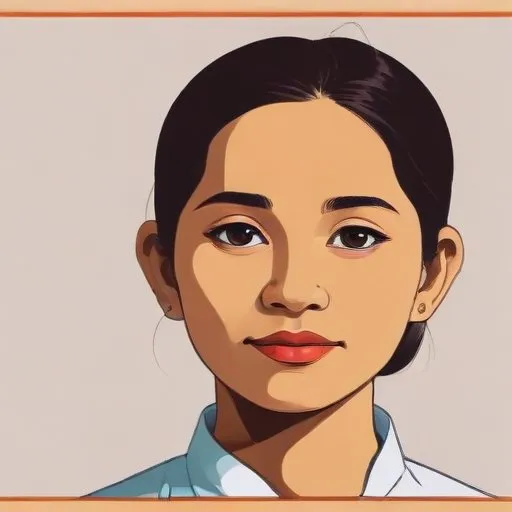
A renowned Burmese painter celebrated for his vibrant, expressive depictions of traditional Myanmar culture and everyday life. His works often blended traditional techniques with modernist elements.
Aung Khin, a Burmese painter, is renowned for being one of the earliest and most prominent modernistic painters in Burma. His work, heavily influenced by European styles, revolutionized the art scene in Mandalay, earning him a prestigious place in the country's art history.
Born on February 13, 1921, in Nat Kyun Aung Myay village, Hsalingyi township, Monywa district, Aung Khin was the youngest of seven children. He began his artistic journey at the age of twelve, studying at his uncle and brothers' mixed art workshop. Later, at sixteen, he moved to Yangon to apprentice under the London-trained Ba Nyan, who specialized in naturalistic and realistic painting.
In 1947, Aung Khin moved to Mandalay, where he became an active member of the Mandalay Artists Association and eventually rose to the positions of Secretary and President. During this time, he associated with Kin Maung Bank, a well-known Mandalay artist who advocated for a modernistic movement in painting in Burma. This association had a profound impact on Aung Khin's work, as he began to experiment with new styles and techniques.
Aung Khin's talent was recognized early on, with a first-prize win for an oil painting in the USIS-sponsored All Burma Competition in 1952. He went on to have several one-man shows in Mandalay and Yangon, including one sponsored by the Burma-America Institute in 1960-61.
In 1978, Aung Khin founded the Panthu Sanda Children's Art Centre along with his daughter, Cho Cho Aung, who is also a painter. This initiative aimed to promote art education among children and foster a love for the arts in the community.
Aung Khin's influence on modern Burmese art is undeniable. He was a pioneer in introducing European styles to the country, and his work paved the way for future generations of artists. Today, his legacy lives on through the Yellow Art Gallery in Mandalay, which he established in 1996 and is now run by his daughter, Cho Cho Aung.
Aung Khin married Tin Tin Aye in Mandalay and had a daughter, Cho Cho Aung, who followed in his footsteps to become a painter. He passed away on May 14, 1996, leaving behind a rich legacy in the world of Burmese art.
Born in 1907
First Prime Minister of Burma, leading the country to independence from British colonial rule and establishing a democratic government. He's also known for his efforts to promote Buddhism and national unity.
Born in 1909
A Burmese educator and diplomat who served as the 3rd United Nations Secretary-General, mediating international conflicts and promoting global cooperation. He's known for his quiet diplomacy and leadership during the Cold War era.
Born in 1910
A Burmese army general and politician who ruled the country with an iron fist, implementing isolationist and nationalist policies that led to economic stagnation and human rights abuses.
81 Years Old
A former general who led Myanmar's transition from military rule to democracy, known for his reforms and release of political prisoners.
