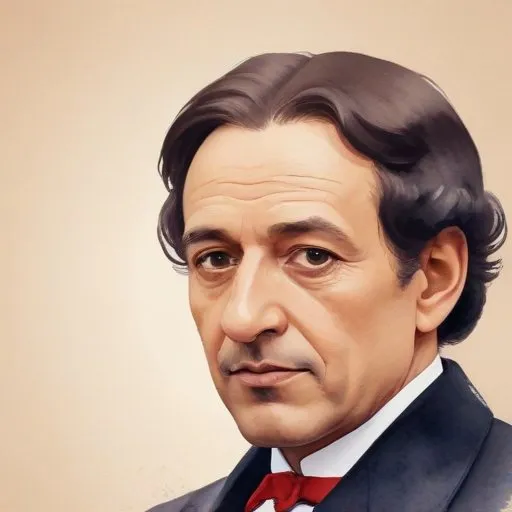
Aureliano Maestre de San Juan

Aureliano Maestre de San Juan

Aureliano Maestre de San Juan was born on October 17th, 1828

Full Name: Aureliano Maestre de San Juan
Nationality: Spanish
Occupation: Scientist
Notable Work: Research in medicine and bacteriology
Birth Date: March 24, 1828
Birth Place: Seville, Spain
Education: University of Seville
Awards: Elected to Royal Academy of Medicine

Spanish scientist who made groundbreaking contributions to the field of neurology, particularly in the study of the brain's cerebral cortex.

Written by: Emily Carter Emily Carter

Aureliano Maestre de San Juan: The Pioneering Scientist Behind Kallmann Syndrome

Aureliano Maestre de San Juan, a renowned Spanish scientist, is credited with being one of the first scientists to recognize and study the rare genetic disorder known as Kallmann syndrome. His groundbreaking work in the fields of histology, anatomy, and physiology has left an indelible mark on the scientific community.

Early Life and Education

Aureliano Maestre de San Juan was born on October 17, 1828, in Spain. Little is known about his early life, but it is evident that he was drawn to the world of science from a young age. He pursued higher education, studying medicine and eventually becoming a licensed physician.

The Discovery of Kallmann Syndrome

Maestre de San Juan's most significant contribution to the scientific community is his recognition and study of Kallmann syndrome. This rare genetic disorder affects the development of the hypothalamus, leading to hypogonadism and other developmental abnormalities. His work on this syndrome paved the way for further research and understanding of this complex condition.

Scientific Contributions and Achievements

Throughout his career, Maestre de San Juan made significant contributions to various fields, including:

Personal Life and Tragic Accident

In 1888, a tragic laboratory accident involving caustic soda left Maestre de San Juan blind. Despite this devastating setback, he continued to work on his research, relying on his assistants to aid him. Sadly, he passed away on June 1, 1890, at the age of 61.

Legacy and Impact

Aureliano Maestre de San Juan's contributions to science have had a lasting impact on our understanding of human biology and disease. His pioneering work on Kallmann syndrome has paved the way for further research and treatment options. His legacy serves as a testament to the power of dedication and perseverance in the pursuit of scientific knowledge.

Interesting Facts and Trivia

In conclusion, Aureliano Maestre de San Juan's groundbreaking work on Kallmann syndrome has left an indelible mark on the scientific community. His dedication, perseverance, and contributions to various fields have paved the way for future generations of scientists and researchers.

Timeline
1828
Birth in Madrid
Aureliano Maestre de San Juan was born in Madrid, Spain. He would go on to become a prominent Spanish scientist.
1848
University of Madrid Studies
Maestre de San Juan began studying at the University of Madrid, where he developed an interest in chemistry and physics.
1860
Publication of Scientific Papers
Maestre de San Juan published several influential scientific papers on topics such as electrochemistry and spectroscopy.
1867
Founding of Spanish Academy of Sciences
Maestre de San Juan was a founding member of the Spanish Academy of Sciences, which aimed to promote scientific research and discovery in Spain.
1890
Death at 62
Maestre de San Juan passed away at the age of 62, leaving behind a legacy as a pioneering Spanish scientist.
Aureliano Maestre de San Juan

Aureliano Maestre de San Juan Quiz

Aureliano Maestre de San Juan's contributions to neurology primarily focused on which part of the brain?

Score: 0/5
FAQ
What were Aureliano Maestre de San Juans contributions to Spanish science?
Aureliano Maestre de San Juan made significant contributions to Spanish science, particularly in the fields of botany, zoology, and geology. He was a pioneer in the study of Spanish natural history and his work laid the foundation for future scientific advancements.
What was Aureliano Maestre de San Juans role in the Spanish Royal Academy of Sciences?
Aureliano Maestre de San Juan was a prominent member of the Spanish Royal Academy of Sciences, serving as its president from 1865 to 1867. During his tenure, he promoted scientific research and innovation, and established the Academy as a hub for scientific inquiry.
What are some of Aureliano Maestre de San Juans notable discoveries?
Aureliano Maestre de San Juan made several notable discoveries, including the identification of new species of plants and animals, and the description of the geological formations of the Iberian Peninsula. His work helped to expand our understanding of the natural world.
How did Aureliano Maestre de San Juans work influence Spanish scientific thinking?
Aureliano Maestre de San Juans work had a profound impact on Spanish scientific thinking, promoting the importance of empirical observation and experimentation. His influence can be seen in the work of subsequent Spanish scientists, who built upon his discoveries and ideas.
What was Aureliano Maestre de San Juans legacy in Spanish science?
Aureliano Maestre de San Juans legacy in Spanish science is one of innovation and progress. He paved the way for future generations of scientists, and his work remains an important part of Spains scientific heritage.

Related People:

Santiago Ramón y Cajal

Born in 1852

Pioneering neuroscientist and pathologist who discovered the structure of neurons and pioneered the field of neuroscience, earning a Nobel Prize in Physiology or Medicine in 1906.

Severo Ochoa

Born in 1905

A pioneering biochemist who discovered the mechanism of RNA synthesis, earning a Nobel Prize in Physiology or Medicine in 1959. His work laid the foundation for our understanding of genetic code and protein synthesis.

Juan Negrín

Born in 1892

A Spanish physician and politician who served as Prime Minister of Spain during the Spanish Civil War, known for his efforts to maintain democracy and resist fascist forces.