


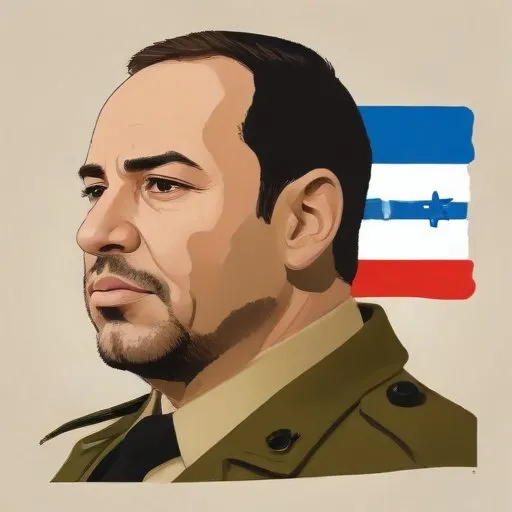
Deputy Prime Minister of Israel, known for his controversial and influential role in shaping the country's foreign policy and national security. A polarizing figure, he's been both praised and criticized for his views on the Israeli-Palestinian conflict.
Avigdor Lieberman, the Soviet-born Israeli politician, is known for his polarizing views and his ability to shape the Israeli political landscape. As the founder and leader of the secular nationalist party Yisrael Beiteinu, he has consistently been a kingmaker in Israel's coalition governments, holding significant influence over the country's political trajectory.
Born on June 5, 1958, in Chiinu, Moldavian SSR, Soviet Union (now Chiinu, Moldova), Lieberman grew up in a Russian-speaking Jewish family. His father, Lev, was a writer who had served in the Red Army and spent seven years in a Siberian exile under Joseph Stalin's rule.
Lieberman entered the Knesset in 1999 and has since served in various roles in the government, including as Minister of National Infrastructure, Minister of Transportation, and Minister of Strategic Affairs. He has also served as Deputy Prime Minister under Prime Ministers Ehud Olmert and Benjamin Netanyahu.
Lieberman's Yisrael Beiteinu party, initially supported by Russian-speaking immigrants from the former Soviet Union, gained significant traction in the 2000s. The party's electoral base expanded to attract broader support, allowing Lieberman to wield significant influence in Israeli politics.
As Minister of Foreign Affairs from 2009 to 2012 and 2013 to 2015, Lieberman played a key role in shaping Israel's foreign policy. He has been a vocal opponent of Palestinian statehood and has advocated for a more hawkish approach to Israel's security.
Lieberman has been embroiled in several controversies throughout his career, including criticisms of his views on Palestinian citizens of Israel, which have been deemed discriminatory by some. He has also faced corruption allegations, which led to his resignation as Defense Minister in 2018.
His opposition to forming a coalition with religious parties has led to tension with other Israeli politicians, particularly Benjamin Netanyahu. Lieberman's refusal to join Netanyahu's coalition in 2019 contributed to the collapse of the government.
Lieberman's political ideology is rooted in secular nationalism, which prioritizes the preservation of Israel as a Jewish state. He has been a vocal critic of what he perceives as the growing influence of religious parties in Israeli politics.
His views on Israel's identity and security have sparked intense debates and criticisms, with some accusing him of promoting a racist and discriminatory agenda. Despite these criticisms, Lieberman remains a significant figure in Israeli politics, with a dedicated base of supporters.
Love him or hate him, Avigdor Lieberman has left an indelible mark on Israeli politics. His ability to shape the country's political landscape and his unwavering commitment to his beliefs have earned him a reputation as a formidable and controversial figure.
As Israel continues to navigate the complexities of the Middle East, Lieberman's influence will undoubtedly be felt for years to come. Whether one agrees with his views or not, it is undeniable that Avigdor Lieberman has been a driving force in Israeli politics, shaping the country's trajectory in ways both profound and provocative.
76 Years Old
The 9th Prime Minister of Israel, a dominant figure in Israeli politics, known for his strong leadership and controversial policies. He has been a central figure in shaping Israel's foreign policy and security strategy.
84 Years Old
A decorated military leader who later navigated Israel's complex political landscape as Prime Minister, known for his efforts to resolve the Israeli-Palestinian conflict.
80 Years Old
The 12th Prime Minister of Israel, a lawyer-turned-politician who played a key role in shaping the country's politics and economy, particularly during the 2006 Lebanon War. He's also known for his corruption charges and subsequent imprisonment.
Born in 1923
A Nobel Peace Prize winner who served as Israel's President and Prime Minister, known for his efforts to bring peace to the Middle East through diplomatic negotiations.
98 Years Old
The 11th Prime Minister of Israel, a military leader who played a key role in shaping the country's history, known for his controversial yet influential decisions that continue to impact the Middle East.
Born in 1922
A renowned Israeli leader and peacemaker who played a crucial role in shaping the country's history and was awarded the Nobel Prize for his efforts towards peace in the Middle East.
Born in 1913
A Belarusian-born Israeli politician who served as Prime Minister of Israel and was awarded the Nobel Peace Prize for his efforts to establish a peace treaty with Egypt. He's known for his strong leadership and commitment to Israeli security.
Born in 1915
The 7th Prime Minister of Israel, serving from 1983 to 1984 and again from 1986 to 1992, known for his hardline stance on Palestinian territories and role in shaping Israel's foreign policy.
