


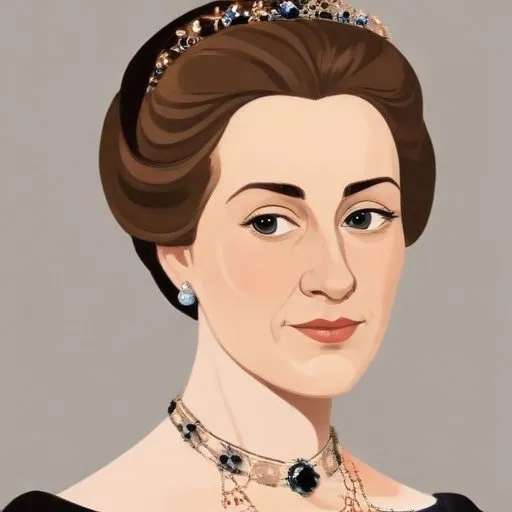
The Duchess of Saxony and Margravine of Meissen was a 15th-century Polish princess who married into the Saxon royal family and played a significant role in promoting cultural and artistic exchange between Poland and Saxony. She's known for her patronage of the arts and education.
As the sixth daughter of King Casimir IV of Poland and Archduchess Elisabeth of Austria, Barbara Jagiellon left an indelible mark on the annals of history as a Polish princess, member of the Jagiellonian dynasty, and Duchess of Saxony.
On November 21, 1496, Barbara married George, Duke of Saxony, in a grand ceremony in Leipzig, attended by an impressive 6,286 German and Polish nobles. This union was a strategic move to maintain good diplomatic relations between Germany and Poland, while also strengthening the Jagiellonian dynasty's position against the rival House of Habsburg.
Barbara's marriage was characterized by deep love and devotion. She frequently wrote letters to her husband while he was away at battles, and witnesses accounts attest to the couple's happiness and affection towards each other. Barbara's passion for the arts was also evident in her patronage of Meissen Cathedral, which she and her husband founded in 1513. The cathedral's altarpiece, crafted by the renowned Lucas Cranach the Elder, remains a testament to her refined taste and culture.
Barbara and George had several children, including Christoph, Johann, Wolfgang, Anna, Christoph (born and died in 1501), Agnes, and Frederick. Although some of their children did not survive to adulthood, their legacy lived on through their descendants.
Barbara's life came to an end on February 15, 1534, at the age of 55. Her husband was so grief-stricken that he grew a beard, earning him the nickname "the Bearded." She was laid to rest in the cathedral of Meissen, in her husband's funeral chapel, built between 1521 and 1524. The couple's burial marked the last time a Prince and Princess of the House of Wettin were interred at the cathedral.
Barbara's life and legacy continue to inspire admiration and respect. Her patronage of the arts, her commitment to her family, and her role in maintaining diplomatic relations between Germany and Poland have left an indelible mark on history. She remains an exemplary figure, embodying the values of love, devotion, and cultural refinement.
In the context of the Renaissance, Barbara's life and marriage reflect the intricate web of alliances and rivalries that shaped European politics and culture. Her legacy serves as a reminder of the significant role that women played in maintaining peace and stability in a tumultuous era.
Born in 1483
A German monk and priest who sparked the Protestant Reformation, challenging Catholic Church authority and shaping Western Christianity. He's famous for nailing 95 theses to a church door, sparking a religious revolution.
Born in 1503
Elector of Saxony who played a key role in the Protestant Reformation and was a prominent leader of the Schmalkaldic League, a defensive alliance of Protestant states. He's also known for being captured and imprisoned by Emperor Charles V.
Born in 1521
A 16th-century German ruler who played a key role in the Protestant Reformation and was a skilled military leader, known for his cunning and diplomacy. He was a significant figure in the complex web of alliances and conflicts of the time.
Born in 1526
A 16th-century German ruler who played a key role in the Protestant Reformation and was a strong supporter of the arts, commissioning many notable works of literature and music.
Born in 1463
A key figure in the early Protestant Reformation, he protected and supported Martin Luther, providing a safe haven for him to translate the Bible into German. He's also known for his role in establishing the University of Wittenberg.
Born in 1585
Ruler of Saxony from 1611 to 1656, known for his role in the Thirty Years' War and his efforts to maintain Saxony's independence. He also supported the arts and architecture, commissioning several notable buildings.
Born in 1564
A 16th-century German nobleman who played a key role in the Protestant Reformation and was a prominent military leader during the Thirty Years' War. He's also known for his cultural achievements, including founding the University of Casimirium.
