


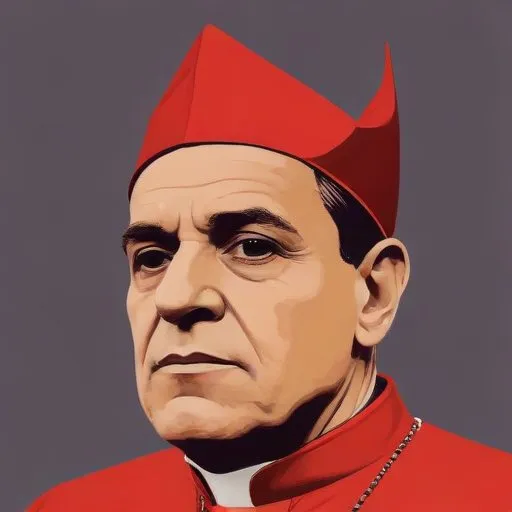
A witty and clever Renaissance figure, known for his clever writings and poems that mocked the Catholic Church, while also serving as a high-ranking cardinal. He's a paradox of wit and piety.
Bernardo Dovizi, better known as Cardinal Bibbiena, was a Renaissance man of letters, a cardinal, and a comedy writer, renowned for his witty plays and clever dialogues. His most famous work, La Calandra, was the first comedy of note written in Italian prose, showcasing his mastery of the genre and earning him a permanent place in the annals of literary history.
Born on August 4, 1470, in Bibbiena, a small town in Tuscany, Dovizi received a thorough literary education, which would serve him well in his later life. His early training laid the foundation for his future success as a writer, preceptor, and boon companion to the powerful Medici family.
In 1494, when the Medici were banished from Florence, Dovizi supported them, a decision that would have far-reaching consequences. His loyalty earned him the protection of Julius II, and soon he was showered with honors at the Roman court. His rise to prominence was swift, and in 1513, Giovanni dei Medici, the future Pope Leo X, appointed him a cardinal, recognizing his tireless efforts in securing his election to the pontifical throne.
As cardinal, Dovizi continued to extend his generous patronage of the arts, befriending artists such as Raphael, whom he had known since his youth. The famous painter created several works for him, including frescoes of a classical and erotic style for his bathroom in the Vatican. Dovizi's own literary pursuits flourished, and his play La Calandra became a sensation in Rome, performed elaborately in the presence of Leo X and Isabella Gonzaga d'Este, Marchioness of Mantua.
La Calandra, also known as Il Calandro and La Calandria, was a groundbreaking work, using the plot of Plautus' Menaechmi to create a modern comedy. Although it contained some immoral scenes, the play's sparkling wit and fine characterization won over audiences, cementing Dovizi's reputation as a master of comedy.
As a cardinal, literary figure, and patron of the arts, Bernardo Dovizi of Bibbiena left an indelible mark on the Renaissance. His play La Calandra remains a testament to his wit and literary prowess, while his friendships with artists like Raphael and his generous patronage of the arts have inspired generations of creatives.
Today, Dovizi is remembered as a multifaceted personality, whose talents knew no bounds. His legacy serves as a reminder of the power of art, literature, and patronage to shape the course of history.
Born in 1535
The second shortest-reigning pope in history, serving for just 27 days in 1605, he is most known for his brief but tumultuous papacy marked by power struggles and controversy.
Born in 1536
Led the Catholic Church during a tumultuous period, issuing papal bulls and playing a key role in the Counter-Reformation. He's also famous for his coffee habit, being the first Pope to try and approve of it.
Born in 1487
A 16th-century Pope who commissioned Michelangelo to paint the Sistine Chapel's frescoes and was a patron of the arts, leaving a lasting impact on Renaissance art and architecture.
Born in 1417
A 15th-century pope who played a significant role in the fall of the Western Schism, ending the division in the Catholic Church. He's also known for his lavish spending and nepotism.
Born in 1504
Leader of the Catholic Church during the Counter-Reformation, he excommunicated Queen Elizabeth I and played a key role in the Council of Trent.
Born in 1502
Introduced the Gregorian calendar, a solar-based calendar that's widely used today, reforming the Julian calendar's inaccuracies.
Born in 1568
The 17th-century Catholic leader who reigned for 21 years, known for his strong stance against Galileo Galilei and his scientific discoveries, as well as his extensive patronage of the arts.
Born in 1611
Led the Catholic Church during a tumultuous period, reforming the Church's finances and combating corruption, while also opposing the French monarch's attempts to exert control over the Church.
