


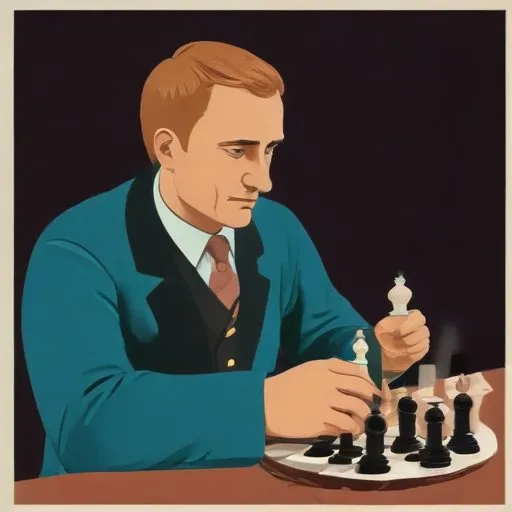
Estonian-German chess master who won several international tournaments and was a leading player in the Baltic region during the early 20th century. Known for his contributions to chess theory and opening systems.
Bernhard Gregory was a Baltic German chess master, known for his remarkable career in the early 20th century. With numerous tournament victories and match wins under his belt, Gregory left an indelible mark on the world of chess.
Born on 22 April 1879 in Reval, Governorate of Estonia, Russian Empire (now Tallinn, Estonia), Gregory was the son of advocate Ferdinand Oscar Gregory and Alexandrine Emmi Gregory. He studied at the Dome School of Reval from 1885 to 1893, before moving to Munich to pursue chemistry and engineering. He later continued his studies in Berlin.
Gregory's chess career took off in the early 1900s, with his first major tournament being the 1902 Hannover Congress, where he tied for 16-19th place. He went on to participate in numerous tournaments throughout Europe, including the Berlin Championship, the DSBCongress, and the All-Russian Masters Tournament.
Gregory's most notable achievement came in 1912, when he won the Breslau Congress, a major tournament of the time. He also tied for 17-18th place in the 1913-1914 St Petersburg All-Russian Masters Tournament, which featured some of the strongest players of the era.
In 1902, Gregory married Ida Hempel from Leipzig, with whom he had two daughters, Iselin (born 1903) and Maud Dolly (born 1905). The couple divorced in 1914, and Ida returned to Leipzig with their daughters.
Bernhard Gregory's contributions to the world of chess are still remembered today. His tournament victories and match wins against strong opponents have earned him a place among the notable chess masters of the early 20th century.
Through his remarkable career, Gregory demonstrated his dedication to the game of chess, and his passion for competition. His legacy continues to inspire chess enthusiasts around the world, and serves as a testament to the power of hard work and determination.
95 Years Old
A Russian chess grandmaster and author, known for his exceptional endgame skill and candid memoirs about the Soviet chess scene.
97 Years Old
Armenian chess grandmaster who reigned as World Chess Champion from 1963 to 1969, known for his defensive playing style and ability to draw games from seemingly impossible positions.
89 Years Old
A Soviet chess grandmaster who dominated the game in the 1960s and 1970s, famously competing against Bobby Fischer in the 1972 World Chess Championship. He is known for his strategic and positional playing style.
Born in 1911
A Soviet chess grandmaster and engineer who dominated the game from the 1940s to 1960s, winning six World Chess Championships and developing the first chess-playing computer program.
Born in 1921
A renowned chess grandmaster and seventh World Chess Champion, known for his strategic and positional playing style, which earned him the title of "Chess Philosopher".
90 Years Old
A legendary chess grandmaster and author, known for his creative and attacking playing style, which earned him the nickname "The Magician of Riga".
75 Years Old
A Soviet chess grandmaster who dominated the game for over a decade, winning numerous championships and earning a reputation as one of the greatest players of all time.
63 Years Old
A Russian chess grandmaster and writer, renowned for being the world's top-ranked player for most of the 1980s and 1990s, and for his advocacy of democracy and human rights.
