


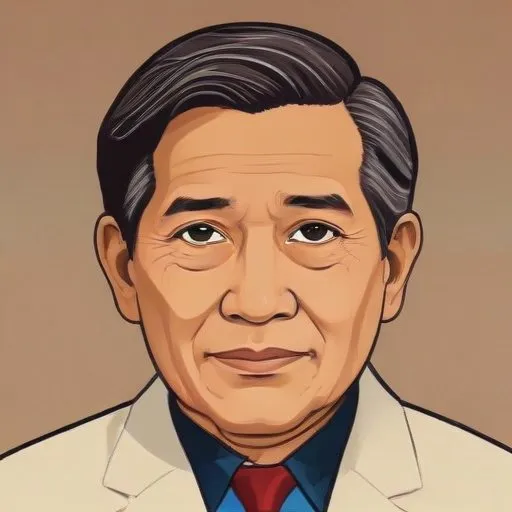
A Filipino journalist and politician who served as the President of the Senate of the Philippines, known for his advocacy on labor rights and social justice. He was a prominent figure in Philippine politics, serving in various government positions.
Blas Fajardo Ople was a Filipino journalist and politician who left an indelible mark on the Philippines' political landscape. He is best known for his 19-year tenure as Secretary and Minister of Labor and Employment, during which he helped author the Labor Code of the Philippines, a landmark legislation that overhauled the country's labor laws.
Ople's journey in public service began early, as a teenager fighting with the guerilla movement against Japanese occupation during World War II. After the war, he pursued a career in journalism, becoming one of the youngest newspaper columnists of his era with his popular "Jeepney Tales" column in the Daily Mirror.
Ople's meteoric rise in politics began in the 1960s, when he became a close ally of President Ferdinand Marcos. He served as Minister of Labor and Employment for 19 years, during which he championed workers' rights and helped shape the country's labor policy. He also established a public relations consulting firm, solidifying his reputation as a master strategist.
In 1999, Ople was elected Senate President, a position he held until 2000. He later served as Secretary of Foreign Affairs from 2002 until his death in 2003. During his tenure, he was a vocal supporter of limited US military presence in the Philippines and American initiatives in the War on Terror, including the 2003 US invasion of Iraq.
Ople's political beliefs underwent a significant transformation over the years. Initially perceived as a leftist-nationalist, he later became a strong advocate for American intervention in the Philippines. Despite these shifts, his commitment to workers' rights and social justice remained unwavering.
Ople was born on February 3, 1927, in Hagonoy, Bulacan, to a family of modest means. He graduated valedictorian of his grade school class and went on to finish his high school studies at the Far Eastern University High School in Manila. He later pursued a degree in liberal arts at the Educational Center of Asia.
Ople received numerous awards and honors for his public service and journalistic excellence. He was awarded the Philippine Legion of Honor, the nation's highest civilian award, and the Ramon Magsaysay Award for Journalism, Literature, and Creative Arts.
Blas Ople's legacy is a testament to his unwavering commitment to public service and social justice. His contributions to the Philippines' labor laws and foreign policy continue to shape the nation's development. As a journalist, politician, and statesman, Ople's impact on Philippine history is undeniable.
"The greatest glory in living lies not in never falling, but in rising every time we fall."
Blas Ople's life and legacy continue to inspire generations of Filipinos, a testament to his enduring impact on Philippine history.
Born in 1907
A Filipino leader who served as president from 1953 to 1957, known for his anti-corruption and social reform efforts, as well as his tragic death in a plane crash.
Born in 1917
A Filipino leader who ruled with an iron fist, implementing martial law and amassing wealth, leaving a legacy of controversy and economic turmoil.
93 Years Old
First female president of the Philippines, led the People Power Revolution, and restored democracy after decades of authoritarian rule.
89 Years Old
The 13th President of the Philippines, a former actor turned politician, is known for his populist appeal and controversial presidency marked by corruption allegations and an eventual impeachment trial. He's also remembered for his efforts to address poverty and inequality.
79 Years Old
The 14th President of the Philippines, a prominent figure in Southeast Asian politics, known for her economic reforms and controversial tenure marked by allegations of corruption and human rights abuses.
98 Years Old
The 12th President of the Philippines, a decorated war hero and leader who implemented economic reforms and brought stability to the country after a tumultuous era. He's known for his efforts to modernize the Philippines and promote national unity.
Born in 1892
This Filipino leader served as the 5th President of the Philippines, playing a key role in rebuilding the country after World War II and shaping its post-war economy. He's remembered for his efforts to restore national sovereignty and promote economic growth.
Born in 1890
The 6th President of the Philippines was a leader who played a crucial role in rebuilding the country after World War II, and is known for his efforts to restore the economy and promote national unity.
