


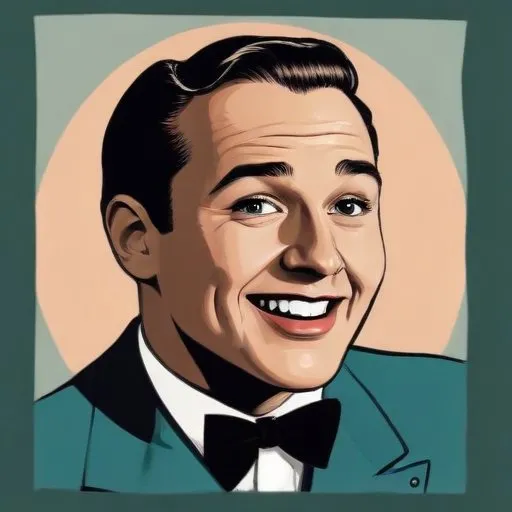
A popular swing singer and bandleader of the 1930s and 1940s, known for his warm, baritone voice and hits like "South Rampart Street Parade" and "Way Back Home".
Known for his soulful voice and infectious energetic stage presence, Bob Crosby is best remembered as the leader of the legendary Bob-Cats, an octet that epitomized the spirit of Dixieland jazz. With a career spanning over four decades, Crosby's contributions to the genre have left an indelible mark on the music world.
Born George Robert Crosby on August 23, 1913, in Spokane, Washington, Bob was the younger brother of the celebrated singer and actor Bing Crosby. Growing up in a musical family, Bob was drawn to music from an early age and began singing in the early 1930s with the Rhythm Boys.
After a stint with Anson Weeks (1931-1934) and the Dorsey Brothers (1934-1935), Crosby formed his own band in 1935, which included many former members of Ben Pollack's band. This marked the beginning of the Bob-Cats, an octet that would become synonymous with Dixieland jazz.
The Bob-Cats, formed in 1935, was an octet that distilled the essence of Dixieland jazz. Featuring soloists from Crosby's larger orchestra, the group's unique sound was characterized by its energetic arrangements, solo improvisations, and a strong emphasis on group interaction.
The Bob-Cats' music was a perfect blend of traditional jazz, swing, and blues, with Crosby's soulful vocals adding an extra layer of emotional depth. The group's popularity soared with hits like "South Rampart Street Parade," "March of the Bob-Cats," and "What's New?"
Crosby's charismatic stage presence and versatility as a performer made him a natural fit for television and radio. He guest-starred in The Gisele MacKenzie Show and was a regular cast member of The Jack Benny Program, both on radio and television, taking over the role of bandleader after Phil Harris's departure.
In the 1950s, Crosby hosted his own afternoon TV variety show on CBS, The Bob Crosby Show, which ran from 1953 to 1957. He also received two stars on the Hollywood Walk of Fame, for television and radio.
Beyond his numerous awards and accolades, Bob Crosby's legacy lies in his contribution to the evolution of Dixieland jazz. His music and style have inspired generations of musicians, including the likes of Louis Armstrong, Duke Ellington, and Glenn Miller.
Crosby's influence extends beyond the music world, too. He served in the U.S. Marine Corps during World War II, leading a band for much of his time in service, and was an active supporter of charitable causes throughout his life.
Born to a family of modest means, Crosby's rise to stardom was a testament to his hard work and dedication. He attended Gonzaga College but dropped out to pursue a career in music.
In his personal life, Crosby was known for his warmth and generosity. He was married twice, first to June Kuhn from 1938 to 1942 and then to Arlene Geller from 1944 until his death on March 9, 1993.
Through his life and music, Bob Crosby left an indelible mark on the world of jazz and beyond. His spirit, energy, and infectious enthusiasm continue to inspire new generations of musicians and music lovers alike.
Born in 1903
Smooth-voiced crooner who dominated the music charts and silver screen with his warm, baritone voice and iconic Christmas tunes.
Born in 1890
A renowned violinist, composer, and bandleader who popularized classical music and jazz, earning the title "The King of Jazz" for his innovative orchestral arrangements. He introduced many Americans to classical music and helped launch the careers of famous musicians like Bing Crosby and Hoagy Carmichael.
Born in 1899
A legendary jazz pianist, composer, and bandleader who revolutionized the genre with his unique style and iconic compositions, such as "Take the A Train" and "Mood Indigo".
Born in 1904
A legendary jazz pianist and bandleader who led a iconic orchestra, blending swing and blues to create a unique sound that influenced generations of musicians. Known for his distinctive "less-is-more" style and hits like "April in Paris" and "One O'Clock Jump".
Born in 1910
A virtuosic clarinetist and innovative bandleader, he revolutionized the swing era with his unique sound and iconic hits like "Begin the Beguine" and "Stardust".
Born in 1904
A legendary trombonist, composer, and bandleader who led one of the most popular big bands of the 1930s and 1940s, creating iconic hits like "In the Mood" and "Moonlight Serenade".
Born in 1912
A renowned saxophonist, composer, and bandleader, known for his iconic big band sound and hits like "Sentimental Journey" and "My Heart Belongs to Daddy".
Born in 1913
A legendary jazz musician and bandleader, known for his virtuosic saxophone and clarinet playing, and leading his iconic orchestra through the swing and bebop eras.
