


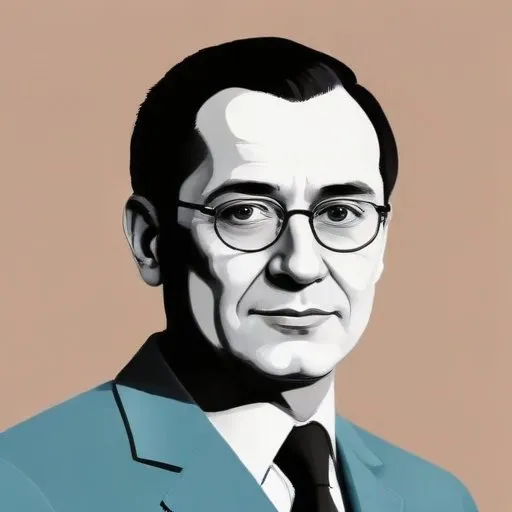
A Romanian economist and engineer who made significant contributions to the development of Romania's economy and industry, particularly in the fields of energy and transportation.
Bogdan Baltazar was a luminary figure in Romania's transition from communism to democracy, serving as the first spokesman of the Romanian government following the fall of the communist regime in 1989. As a seasoned banker and financial advisor, he played a pivotal role in shaping the country's economic trajectory.
Baltazar was born on September 22, 1939, in Bucharest, Romania. He pursued his passion for mechanical engineering at the Politehnica University of Bucharest, graduating in 1962. His academic pursuits didn't stop there; he went on to earn a master's degree in economics from the CUNY Graduate Center, City University of New York, in 1971, followed by a Ph.D. in International Relations from the University of Bucharest in 1964.
Baltazar's illustrious career spanned multiple domains. He began as a diplomat, serving as the first diplomatic secretary and later as the manager of the Africa division in the Ministry of Foreign Affairs from 1971 to 1981. After a brief hiatus, he returned to the ministry in 1990, taking charge of the Northern and Southern America divisions.
His most notable role, however, was as the spokesman for Prime Minister Petre Roman from 1989 to 1991, during which he was lauded for his humor and charm by journalists. This period marked a significant milestone in Romania's transition to democracy, and Baltazar's role was instrumental in shaping the country's narrative.
Following his stint as spokesman, Baltazar ventured into banking, working as a senior banking adviser and coordinator for the banking group for Romania in London from 1991 to 1996. He then took on various leadership roles, including vice president of the State Property Fund FPS (1997-1998) and director of the French-owned Romanian Bank for Development BRD (1998-2004). He later led a consultancy firm, focusing on Central European countries, before being reappointed as director of BRD in 2011.
Baltazar's personal life was marked by humility and dedication to his family. He was married and had two children. Unfortunately, his life was cut short when he passed away on December 28, 2012, at the age of 73, due to cancer.
Despite his passing, Baltazar's legacy continues to inspire generations of Romanians. His contributions to the country's economic development, his role in shaping its democratic narrative, and his dedication to his family have cemented his place as one of Romania's most esteemed figures.
Baltazar's experiences as a diplomat and banker gave him a unique perspective on the importance of economic development and democratization. He believed in the power of economic growth to drive social change and was committed to creating a prosperous Romania.
Throughout his career, Baltazar demonstrated a deep understanding of the intricacies of international relations and the importance of building strong diplomatic ties. His leadership style was marked by humility, humor, and a willingness to listen, earning him the respect of his peers and contemporaries.
Baltazar's influence on modern Romanian society is multifaceted. His role in shaping the country's economic landscape has had a lasting impact on generations of Romanians. His commitment to democratization and his contributions to the country's transition from communism to democracy have inspired countless individuals.
As a respected figure in the banking industry, Baltazar's leadership and expertise have helped shape the country's financial sector. His legacy continues to inspire young professionals and entrepreneurs, encouraging them to strive for excellence in their chosen fields.
Throughout his illustrious career, Baltazar received numerous awards and honors for his contributions to Romania's economic development and democratization. While specific awards are not documented, his legacy is a testament to his dedication and commitment to his country.
In conclusion, Bogdan Baltazar's remarkable journey serves as a beacon of inspiration to future generations. His unwavering commitment to his country, his family, and his profession has left an indelible mark on Romania's history.
Born in 1912
A Nobel Prize-winning economist who championed free market capitalism and limited government intervention, known for his advocacy of laissez-faire economics and influential writings on monetary policy.
83 Years Old
A Nobel Prize-winning economist and academic who has made significant contributions to the field of economics, particularly in the areas of information economics and globalization.
73 Years Old
A Nobel Prize-winning economist and academic who has made significant contributions to the field of international trade and economic geography, and is also a prominent columnist and author.
92 Years Old
A renowned economist and philosopher who has made significant contributions to welfare economics, social choice theory, and development economics, and is known for his work on poverty, famine, and human development.
95 Years Old
A pioneer in applying economic theory to social issues, he's most known for his work on human capital, crime and punishment, and the economics of the family.
93 Years Old
A Nobel Prize-winning economist who developed the theory of optimum currency areas and is known for his work on international economics and exchange rates.
Born in 1918
A Nobel laureate who developed the Tobin tax, a levy on international currency transactions to reduce speculation and stabilize economies. His work has shaped modern economic policy and global finance.
71 Years Old
A renowned economist and academic who served as the Chief Economist of the World Bank and Secretary of the Treasury, known for his influential economic policies and theories.
