


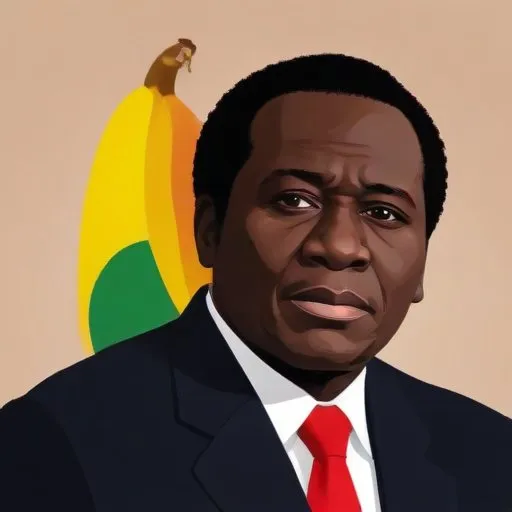
First President of Zimbabwe, serving from 1980 to 1987, known for his role in the country's transition from white minority rule to majority rule. He was a Methodist minister and politician who played a key role in the fight for independence.
Canaan Banana, a Zimbabwean Methodist minister, theologian, and politician, is best known for serving as the first President of Zimbabwe from 1980 to 1987, following the country's independence from British colonial rule. He played a pivotal role in the country's transition to a majority-rule democracy, earning him a place in history as a champion of black liberation and African nationalism.
Canaan Banana was born on March 5, 1936, in Essexvale (now Esigodini), a village in Matabeleland, Southern Rhodesia. His mother was an Ndebele, and his father was a Mosotho. He received his education at a mission school before studying at Epworth Theological College in Salisbury (now Harare).
Banana was ordained as a Methodist minister in 1962 and worked as a school administrator between 1963 and 1966. He became involved in anticolonial politics, embracing black liberation theology and criticizing the Rhodesian government under Ian Smith. He became Vice-President of the African National Congress, but soon was forced to flee Rhodesia.
During his exile, Banana studied at Wesley Theological Seminary in Washington, D.C., United States. He worked for the All Africa Conference of Churches and was a member of the Advisory Committee of the World Council of Churches. Upon returning to Rhodesia in 1975, he was imprisoned until 1976. That year, he accompanied Robert Mugabe to the Geneva Conference, and in 1979, he attended the Lancaster House Conference in London that resulted in Zimbabwe's independence as a majority-rule democracy.
In 1980, Banana became the first President of Zimbabwe, serving until 1987. During his presidency, he worked to establish a new government and promote national unity. He stepped down as President and was succeeded by Prime Minister Robert Mugabe, who became the country's executive president.
In 1997, Banana was accused of being a homosexual, and after a highly publicized trial, he was convicted of 11 counts of sodomy and unnatural acts. He served six months in prison. The trial and conviction remain a controversial episode in Banana's life and legacy.
Canaan Banana's legacy is complex and multifaceted. While his presidency marked a significant milestone in Zimbabwe's transition to independence, his later trial and conviction remain a controversial episode in his life and legacy. Despite this, Banana's commitment to black liberation and African nationalism continues to inspire and influence political and social movements across the continent.
Banana's theological work and writings reflected his commitment to black liberation theology and African nationalism. He believed in the importance of African self-determination and the need for African countries to assert their independence and autonomy.
Banana's life and legacy have inspired numerous artistic and cultural works, including literature, music, and film. His story has become a powerful symbol of African resistance and resilience in the face of colonialism and oppression.
Banana received numerous awards and honors for his work and contributions to Zimbabwe's independence and development. Despite his later controversy, his legacy continues to be recognized and celebrated across Africa and the world.
Born in 1924
The 2nd President of Zimbabwe, a controversial figure who ruled with an iron fist, known for his country's economic downfall and human rights abuses.
Born in 1917
A key figure in Zimbabwe's fight for independence, leading the Zimbabwe African People's Union and serving as Vice President, playing a crucial role in shaping the country's modern history.
Born in 1925
First black prime minister of Zimbabwe Rhodesia, serving from 1979 to 1980, known for his attempts to bring about racial reconciliation and transition to majority rule.
69 Years Old
A former cricketer turned sportscaster, known for his commentary and analysis of the sport, particularly in New Zealand.
Born in 1917
A leading figure in the fight against apartheid, he served as President of the African National Congress and played a crucial role in mobilizing international opposition to the racist regime.
Born in 1918
A South African lawyer and politician who fought against apartheid, becoming the country's first black president and a symbol of racial reconciliation, earning a Nobel Peace Prize. He's a beacon of hope and freedom.
84 Years Old
The second President of South Africa, a key figure in the country's transition from apartheid to democracy, known for his economic reforms and HIV/AIDS controversy.
84 Years Old
The 4th President of South Africa, a controversial figure known for his corrupt regime and multiple scandals, including bribery and racketeering charges. He was also a key figure in the fight against apartheid.
