


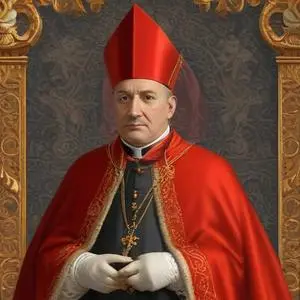
Chief minister of France during a pivotal period, shaping the country's politics and economy, and known for his cunning and diplomatic prowess.
Cardinal Jules Mazarin is predominantly known for his exceptional diplomatic skills and shrewd politics, which earned him the position of Chief Minister of France from 1642 to 1661. During his tenure, he crafted and implemented policies that significantly influenced the country's foreign and domestic affairs, earning him the reputation as one of the most powerful and cunning politicians of his time.
Born on July 14, 1602, in Pescina, Italy, Mazarin was educated at the Jesuit College in Rome, where he honed his exceptional diplomatic and linguistic skills. He later moved to Paris, where he became a naturalized French citizen and began his political career as a secretary to Cardinal Richelieu.
After Richelieu's death in 1642, Mazarin became the favorite of Queen Anne of Austria, regent for her son Louis XIV, and soon rose to power as the Chief Minister of France. He skillfully navigated the complex web of European politics, forming alliances and negotiating treaties that secured France's position as a dominant power.
Mazarin was a staunch advocate for the principles of raison d'état, which emphasized the importance of state interests above individual or religious concerns. He believed in the divine right of kings, and his policies often reflected this ideology.
Despite his prominent position, Mazarin's personal life was marked by controversy and scandal. He was known for his lavish lifestyle, extravagant spending, and numerous love affairs. His closest confidant and rumored lover, Anne de Neubourg, exerted significant influence over his decisions.
Mazarin's legacy extends beyond his political achievements. He was a patron of the arts, and his love for literature and music encouraged the development of French culture. His diplomatic efforts laid the groundwork for the modern concept of international relations and the balance of power in Europe.
"L'état c'est moi" ("I am the state"), a phrase often attributed to Louis XIV, was actually coined by Mazarin, reflecting his belief in the absolute authority of the monarch.
Mazarin's life and policies must be viewed within the context of the tumultuous 17th century, marked by religious wars, political upheaval, and the rise of absolute monarchies. Despite controversy and criticism, his contribution to French history and politics is undeniable, earning him a place among the most influential figures of his time.
Mazarin's diplomatic prowess and Machiavellian politics have drawn comparisons to contemporaries like Cardinal Richelieu and Oliver Cromwell. While his methods were often questionable, his achievements undeniably shaped the course of French history.
1602: Born in Pescina, Italy
1642: Becomes Chief Minister of France
1648: Peace of Westphalia and Cardinalate
1653: Quells the Fronde Rebellion
1661: Dies in Vincennes, France
Born in 1585
A powerful and cunning statesman who dominated French politics during the 17th century, known for his ruthless suppression of dissent and centralization of power. He was a master strategist and diplomat who shaped the course of European history.
Born in 1601
The queen who ruled France alongside her son Louis XIV, known as the Sun King, and played a significant role in shaping the country's politics and culture during the 17th century. She was a skilled diplomat and strategist who helped to establish France as a dominant European power.
Born in 1619
A 17th-century mastermind who centralized France's economy, creating a powerful and efficient financial system that fueled the country's growth and prosperity. He's renowned for his innovative economic policies and reforms.
