


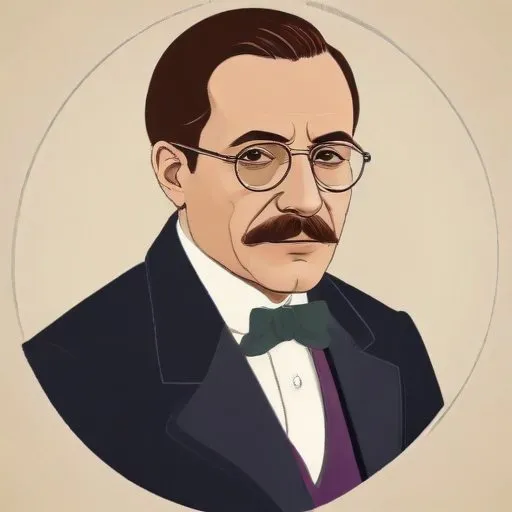
Developed a process for producing aluminum oxide, a crucial step in aluminum production, and made significant contributions to the field of inorganic chemistry. His work revolutionized the aluminum industry.
Carl Josef Bayer, an Austrian-Hungarian chemist, revolutionized the world of metallurgy with his groundbreaking invention – the Bayer process of extracting alumina from bauxite, a crucial step in the economical production of aluminium. This pioneering achievement, patented in 1888, not only transformed the aluminium industry but also left an indelible mark on modern society.
Born on March 4, 1847, in the Duchy of Upper and Lower Silesia, Austrian Empire (now Poland), Bayer's fascination with chemistry began at a young age. He pursued his passion at Heidelberg University in Germany, where he studied under the renowned Robert Bunsen, the inventor of the Bunsen burner. Bayer received his doctorate degree in 1871 with a dissertation on the chemistry of indium, a recently discovered element at the time.
After completing his doctorate, Bayer lectured at Technische Hochschule in Brno for two years, before establishing his own research company. In 1885, he moved to St. Petersburg, where he would flourish as an inventor. It was during this period that Bayer developed a method to provide alumina to the textile industry, which used it as a fixing agent in the dyeing of cotton.
In 1887, Bayer discovered that aluminium hydroxide precipitated from an alkaline solution, which could be filtered and washed more easily than that precipitated from an acid medium by neutralization. This breakthrough led to the development of his four-stage process of extracting alumina from bauxite ore, patented in 1888.
The Bayer process, combined with the Hall-Héroult process, caused the price of aluminium to drop by approximately 80% in 1890, making it more accessible and affordable for widespread use. This significant decrease in price paved the way for aluminium to become a versatile and essential material in various industries, including aerospace, transportation, and construction.
In 1892, at the age of 45, Bayer married Alma Von Witte, the daughter of a Russian politician, and settled in Rietzdorf (modern-day Reica ob Paki, Slovenia). The couple had six children together. Bayer passed away on October 4, 1904, at the age of 57, leaving behind a legacy that would continue to shape the world. His wife, Alma, survived him until 1962, passing away at the remarkable age of 94.
Although there are no direct quotes from Carl Josef Bayer, his work and achievements speak volumes about his dedication to innovation and perseverance. His pioneering spirit continues to inspire generations of scientists, engineers, and entrepreneurs.
Although there are no specific awards or honors attributed to Carl Josef Bayer, his contribution to the development of the aluminium industry is widely recognized and celebrated.
Carl Josef Bayer's remarkable journey serves as a testament to the power of innovation, perseverance, and dedication. His groundbreaking work continues to have a profound impact on modern society, making him an icon in the world of metallurgy and chemistry.
Born in 1868
Developed a process to synthesize ammonia, revolutionizing agriculture and warfare, and was awarded the Nobel Prize in Chemistry in 1918.
Born in 1874
Developed the Haber-Bosch process, a method to produce ammonia on an industrial scale, revolutionizing fertilizer production and agriculture. This innovation had a profound impact on global food supply and population growth.
Born in 1833
A Swedish chemist and engineer who invented dynamite and established a prestigious award recognizing outstanding contributions in fields like literature, peace, and science.
Born in 1853
A Latvian-German chemist and academic who pioneered work on catalysis, chemical equilibria, and reaction rates, earning a Nobel Prize in Chemistry in 1909. He's also credited with developing the Ostwald process for producing nitric acid.
Born in 1852
Pioneering chemist who discovered the laws of chemical equilibrium and osmotic pressure, revolutionizing our understanding of chemical reactions.
Born in 1835
German chemist and Nobel laureate who synthesized barbituric acid and developed the theory of organic dyes, revolutionizing the textile industry. His work laid the foundation for modern dye chemistry.
Born in 1852
A German chemist and academic who won the Nobel Prize for synthesizing amino acids and sugars, and establishing the structure of purines, revolutionizing the field of organic chemistry.
Born in 1871
A French chemist and academic who developed the Grignard reaction, a crucial process in organic chemistry that enables the formation of carbon-carbon bonds, revolutionizing the field.
