


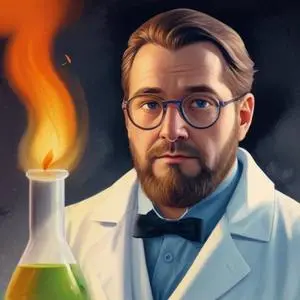
A pioneer in chemistry, known for inventing the Bunsen burner, a laboratory device still widely used today for heating and combustion experiments.
Robert Bunsen, a German chemist, is best known for his groundbreaking work in spectroscopy, which led to the discovery of caesium and rubidium, and the development of the iconic Bunsen burner. Through his pioneering research, Bunsen paved the way for a deeper understanding of the properties of elements and their interactions with light.
Born on March 30, 1811, in Göttingen, Germany, Bunsen was the youngest of four sons of Christian Bunsen, a professor of modern philology and chief librarian of the University of Göttingen. He matriculated at Göttingen in 1828 and studied chemistry with Friedrich Stromeyer, mineralogy with Johann Friedrich Ludwig Hausmann, and mathematics with the renowned Carl Friedrich Gauss. Bunsen obtained his PhD in 1831 and spent the next two years traveling through France, Germany, and Austria, where he met prominent scientists such as Friedlieb Runge and Justus von Liebig.
In 1833, Bunsen became a lecturer at Göttingen, where he began his experimental studies on the insolubility of metal salts of arsenous acid. His research led to the discovery of the use of iron oxide hydrate as a precipitating agent, which remains the most effective antidote against arsenic poisoning to this day. Bunsen's work in this area was published in conjunction with the physician Arnold Adolph Berthold.
In 1836, Bunsen took up a position at the Polytechnic School of Kassel, where he taught for three years. During this period, he developed several gas-analytical methods and pioneered the field of photochemistry. His work in organic arsenic chemistry also laid the foundation for future research in the field.
In collaboration with his laboratory assistant, Peter Desaga, Bunsen developed the Bunsen burner, a significant improvement over laboratory burners in use at the time. This invention enabled him to investigate the emission spectra of heated elements, leading to the discovery of caesium in 1860 and rubidium in 1861, along with physicist Gustav Kirchhoff. The Bunsen-Kirchhoff Award for spectroscopy was later established in recognition of their pioneering work.
Bunsen's contributions to chemistry and physics have had a lasting impact on our understanding of the properties of elements and their interactions with light. His work in spectroscopy paved the way for the development of modern analytical techniques and has had significant applications in fields such as astronomy and materials science.
Through his tireless efforts, Bunsen inspired a generation of scientists, including notable figures such as Dmitri Mendeleev and William Ramsay. His legacy continues to influence research and discovery in the fields of chemistry and physics.
Robert Bunsen's remarkable contributions to science have left an indelible mark on our understanding of the natural world. His pioneering work in spectroscopy and his invention of the Bunsen burner have inspired generations of scientists and continue to influence research and discovery today.
Born in 1800
German chemist and academic who synthesized urea, debunking the theory of vitalism, and made significant contributions to organic chemistry. He is considered one of the founders of modern organic chemistry.
Born in 1803
Developed groundbreaking theories on organic chemistry and agriculture, revolutionizing farming practices and earning the title "Father of Fertilizers".
Born in 1818
Developed the theory of chemical structure and introduced the concept of synthetic chemistry, revolutionizing the field of organic chemistry.
Born in 1743
Father of modern chemistry, discovered oxygen, and developed a systematic method of chemical nomenclature. He laid the foundation for modern chemistry and paved the way for future scientific discoveries.
Born in 1742
A pioneering pharmaceutical chemist who discovered oxygen, chlorine, and other elements, and made significant contributions to the field of chemistry.
Born in 1778
Pioneering chemist and physicist who discovered several elements, including potassium and sodium, and invented the Davy lamp, a safety lamp for miners. His groundbreaking work laid the foundation for modern chemistry and electrochemistry.
Born in 1791
Pioneering scientist who discovered electromagnetic induction, formulated the laws of electrolysis, and invented the first electrical generator, revolutionizing our understanding of electricity and its applications.
