


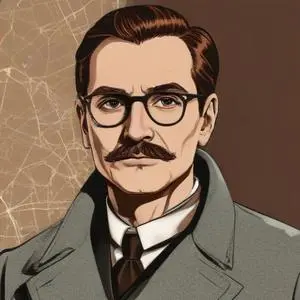
Developed fundamental laws of thermodynamics and electromagnetism, shaping our understanding of energy and its interactions.
Gustav Kirchhoff, a German physicist and mathematician, is best known for his groundbreaking contributions to the fundamental understanding of electrical circuits, spectroscopy, and the emission of blackbody radiation by heated objects. His work has left an indelible mark on the fields of physics and engineering, and his laws and concepts continue to shape our understanding of the natural world.
Kirchhoff was born on March 12, 1824, in Knigsberg, Prussia (now Kaliningrad, Russia), to Friedrich Kirchhoff, a lawyer, and Johanna Henriette Wittke. He graduated from the Albertus University of Knigsberg in 1847, where he was heavily influenced by his professors Carl Gustav Jacob Jacobi, Franz Ernst Neumann, and Friedrich Julius Richelot.
Kirchhoff's most notable contributions include:
In 1854, Kirchhoff moved to the University of Heidelberg, where he collaborated with Robert Bunsen on spectroscopic work. Together, they invented the spectroscope, which Kirchhoff used to pioneer the identification of elements in the Sun's atmosphere. In 1857, he calculated that an electric signal in a resistanceless wire travels at the speed of light.
Kirchhoff's contributions have been recognized with several awards and honors, including the Bunsen-Kirchhoff Award for spectroscopy, established in his and Bunsen's names.
Kirchhoff married twice, first to Clara Richelot, with whom he had five children, and later to Luise Brmmel. He died on October 17, 1887, leaving behind a legacy that continues to inspire and shape the fields of physics and engineering.
Today, Kirchhoff's work remains a testament to his groundbreaking spirit and his ability to challenge and expand our understanding of the natural world.
Born in 1822
Developed the theory of thermodynamics, introducing the concept of entropy, and made significant contributions to the fields of electricity and magnetism.
Born in 1831
Developed groundbreaking theories that unified electricity and magnetism, and predicted the existence of radio waves, revolutionizing our understanding of the physical world.
Born in 1857
A pioneer in the field of electromagnetism, he discovered radio waves and proved James Clerk Maxwell's theories, paving the way for modern wireless communication. His experiments led to the development of radio, television, and mobile phones.
Born in 1844
Developed the theory of statistical mechanics, which explains the behavior of gases and is a fundamental concept in modern physics.
Born in 1838
A pioneer in modern physics, he challenged traditional notions of space and time, and his critique of Newton's laws paved the way for Einstein's relativity. He also made significant contributions to psychology and philosophy.
