


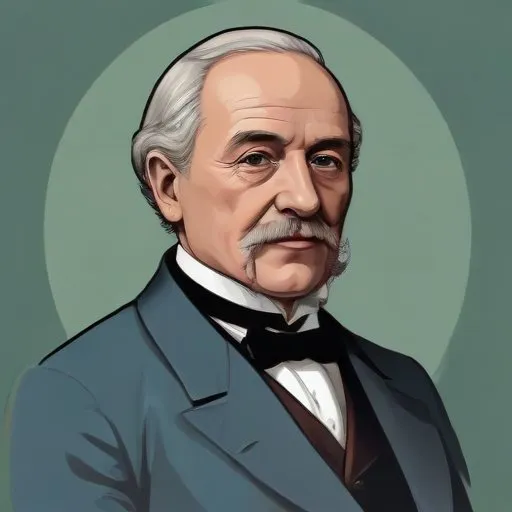
Developed the theory of the vibrating molecule, which laid the foundation for modern crystallography and contributed significantly to the understanding of mineral structures.
Franz Ernst Neumann, a German mineralogist and physicist, is widely recognized for his groundbreaking contributions to the fields of crystallography, optics, and elasticity. His work, particularly the development of Neumann's Law, has had a lasting impact on our understanding of the physical properties of compounds.
Born on September 11, 1798, in Joachimsthal, Margraviate of Brandenburg, near Berlin, Neumann grew up in a time of great scientific discovery. His early interest in science was temporarily interrupted when he served as a volunteer in the Hundred Days against Napoleon, where he was wounded in the Battle of Ligny. After the war, he pursued his passion for science, initially studying theology at Berlin University before shifting his focus to scientific subjects.
Neumann's academic career began at the University of Königsberg, where he was appointed as a Privatdozent in 1828 and later became an ordinary professor of mineralogy and physics in 1829. His research on crystallography and specific heats of compounds led to the development of Neumann's Law, which states that the molecular heat of a compound is equal to the sum of the atomic heats of its constituents. This fundamental principle has far-reaching implications for our understanding of chemical reactions and the properties of materials.
Neumann's work in optics was equally groundbreaking. He developed a rigorous dynamical calculation that agreed with the results obtained by Augustin-Louis Cauchy, and he succeeded in deducing laws of double refraction closely resembling those of Augustin-Jean Fresnel. His assumption that the symmetry of the elastic behavior of a crystal was equal to that of its form led to a significant reduction in the number of independent constants and greatly simplified the elastic equations.
Neumann's contributions to science have had a lasting impact on our understanding of the physical properties of materials. His work in crystallography, optics, and elasticity has influenced generations of scientists and engineers. His application of symmetry in elasticity, formalized by his student Woehler, has become a fundamental principle in the field.
Throughout his career, Neumann was committed to education and the advancement of scientific knowledge. He wrote numerous papers and books on his research, sharing his findings with the scientific community and inspiring future generations of scientists.
"The symmetry of the elastic behavior of a crystal is equal to that of its form."
Neumann's contributions to science have been recognized and honored through various awards and honors. His work has been widely cited and built upon, and he is remembered as a pioneer in the fields of mineralogy and physics.
Born in 1822
Developed the theory of thermodynamics, introducing the concept of entropy, and made significant contributions to the fields of electricity and magnetism.
Born in 1831
Developed groundbreaking theories that unified electricity and magnetism, and predicted the existence of radio waves, revolutionizing our understanding of the physical world.
Born in 1791
Pioneering scientist who discovered electromagnetic induction, formulated the laws of electrolysis, and invented the first electrical generator, revolutionizing our understanding of electricity and its applications.
Born in 1775
A pioneer in the field of electromagnetism, he formulated fundamental laws that describe the relationship between electric currents and magnetic fields. His work laid the foundation for many modern technologies, including electric motors and generators.
Born in 1777
A pioneer in mathematics and physics, he made major contributions to number theory, algebra, and electromagnetism, shaping our understanding of the natural world.
Born in 1777
Danish physicist and chemist who discovered the principle of electromagnetism and founded the field of electromagnetism, making significant contributions to our understanding of electricity and magnetism.
Born in 1789
Formulated laws governing the relationship between voltage, current, and resistance in electric circuits, revolutionizing the field of electrical engineering.
Born in 1804
Developed the first electromagnetic theory of light and made significant contributions to the understanding of electricity and magnetism. He's also credited with inventing the first electromagnetic telegraph.
