


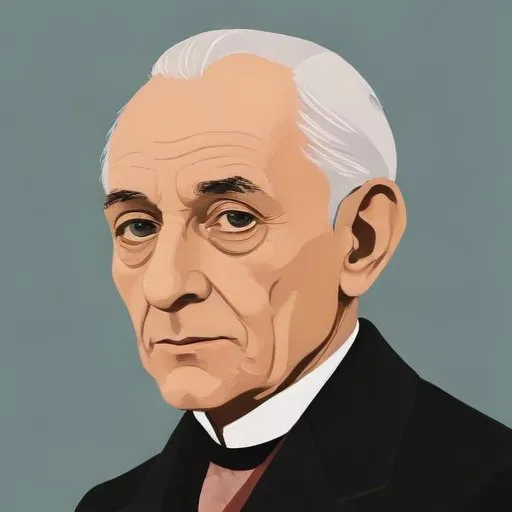
A Swiss poet and author who wrote epic verse and novels that explored the human condition, earning him the Nobel Prize in Literature in 1919.
Carl Spitteler, a Swiss poet, is best known for being awarded the Nobel Prize for Literature in 1919 for his epic poem Olympian Spring, a work that showcases his mastery of both pessimistic and heroic poetry. This novel contribution to the world of literature cemented his status as one of the most revered poets of his time.
Born on April 24, 1845, in Liestal, Switzerland, Spitteler was the son of a government official, Federal Secretary of the Treasury. He attended the gymnasium at Basel, where he was taught by prominent scholars such as philologist Wilhelm Wackernagel and historian Jakob Burckhardt. Later, he studied law at the University of Zurich and theology in Heidelberg and Basel.
Spitteler's true calling was as an epic poet, which he realized early on. He declined a position as a pastor, opting instead to pursue his passion for poetry. This decision led him to work as a tutor in Russia from 1871 to 1879, where he began to develop his unique writing style.
In 1881, under the pseudonym Carl Felix Tandem, Spitteler published Prometheus and Epimetheus, an allegoric prose poem that explores the contrast between ideals and dogmas through the mythological figures of Prometheus and Epimetheus. This work received an extended psychological exegesis by Carl Gustav Jung in his 1921 book Psychological Types. Spitteler later reworked the poem as Prometheus the Sufferer, published in 1924 under his true name.
Spitteler's writing career spanned multiple genres, including poetry, short stories, and journalism. He published Extramundana, a collection of poems, in 1882. In 1891, he released Friedli, der Kalderi, a collection of short stories. He worked as a journalist for Der Kunstwart and later became an editor for Neue Zrcher Zeitung.
Spitteler's most notable achievement was being awarded the Nobel Prize for Literature in 1919 for his epic poem Olympian Spring. This recognition solidified his position as a prominent figure in the literary world.
Spitteler married Marie op der Hoff in 1883, whom he had previously taught in Neuveville. He passed away on December 29, 1924, leaving behind a rich literary legacy that continues to inspire generations of writers and poets.
Through his works, Spitteler continues to be celebrated for his unique blend of pessimistic and heroic poetry, which has left an indelible mark on the world of literature.
Born in 1749
A German literary giant who penned iconic works like "Faust" and "The Sorrows of Young Werther", shaping the Romantic movement and influencing countless writers.
Born in 1819
A 19th-century literary mastermind, celebrated for his vivid storytelling and poetic flair, particularly in his novel "Green Henry", which explores the human condition. His works are considered a cornerstone of Swiss literature.
Born in 1875
A visionary poet and novelist who explored the human condition through lyrical and philosophical works, delving into the mysteries of existence, love, and the self.
Born in 1877
A renowned poet, novelist, and painter, celebrated for his thought-provoking and introspective works that explore the human condition, spirituality, and the search for meaning. His writings often blended elements of psychology, philosophy, and mysticism.
Born in 1875
A renowned literary mastermind, celebrated for crafting complex, psychologically rich novels that probed the human condition, often blending philosophy and art.
Born in 1871
A prominent literary figure of the early 20th century, known for his socially critical and psychologically nuanced novels that explored the darker aspects of German society. His works often targeted the bourgeoisie and the rise of fascism.
Born in 1905
A Bulgarian-Swiss writer who explored the human condition through novels, plays, and memoirs, winning the Nobel Prize in Literature in 1981 for his thought-provoking works.
