


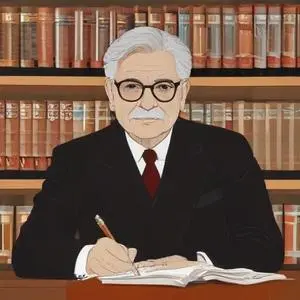
A Bulgarian-Swiss writer who explored the human condition through novels, plays, and memoirs, winning the Nobel Prize in Literature in 1981 for his thought-provoking works.
Elias Canetti, the Bulgarian-born German-language writer, is renowned for his thought-provoking works that have left an indelible mark on literature. His writings, characterized by a broad outlook, wealth of ideas, and artistic power, earned him the prestigious Nobel Prize in Literature in 1981.
Born on July 25, 1905, in Ruse, Bulgaria, Canetti was the eldest of three sons to businessman Jacques Canetti and Mathilde Arditti. His ancestors were Sephardic Jews, with roots tracing back to the 14th century. Canetti's early years were marked by a series of relocations, first to Manchester, England, and later to Vienna, following his father's sudden death in 1912.
Canetti's literary career spanned multiple genres, including novels, plays, memoirs, and non-fiction works. His notable works include Crowds and Power,
Canetti's writings were deeply influenced by his fascination with philosophy, particularly the works of Friedrich Nietzsche and Arthur Schopenhauer. He was drawn to the concepts of individualism, the will to power, and the role of the masses in shaping human history. His philosophical musings are reflected in his literary works, which often grappled with the complexities of human existence.
Canetti's literary prowess was recognized with numerous awards and honors, including the Nobel Prize in Literature in 1981. He also received the Büchner Prize in 1966 and the Nellie Sachs Prize in 1969.
Canetti became a British citizen in 1952, after fleeing Nazi persecution in 1938. He maintained a strong connection to his Bulgarian roots, despite his peripatetic life. His personal relationships were characterized by intense intellectual and emotional connections, including his marriage to writer Veza Taubner-Calderon.
Canetti's works have had a profound impact on modern society, influencing writers, philosophers, and thinkers across generations. His ideas on crowd psychology and the dynamics of power have been applied in fields beyond literature, including sociology, psychology, and politics.
Canetti's literary legacy is often compared to that of his contemporaries, including Thomas Mann and Hermann Broch. While sharing similarities with these writers, Canetti's unique perspective and style have cemented his position as a prominent figure in modern literature.
Through his remarkable body of work, Elias Canetti has left an indelible mark on literature and philosophy. His ideas continue to inspire and challenge readers, cementing his legacy as one of the most important writers of the 20th century.
Born in 1883
A writer of surreal, psychologically complex fiction that explores the human condition, often featuring isolated protagonists in absurd, nightmarish scenarios.
Born in 1913
A French novelist, philosopher, and journalist who wrote influential works like "The Stranger" and "The Plague", exploring absurdism and the human condition.
Born in 1905
Existentialist philosopher and playwright who argued that humans have complete freedom to choose their actions and create their own meaning in life, influencing modern thought on morality and individual responsibility.
Born in 1889
A German philosopher and academic who explored the meaning of existence, time, and human existence, influencing 20th-century philosophy with his concept of "Being-in-the-world".
Born in 1903
A critical theorist who critiqued modern society, culture, and capitalism, arguing that they perpetuate inequality and stifle individual freedom. His work influenced many fields, from sociology to musicology.
Born in 1892
A German philosopher and critic who analyzed the impact of technology on society, particularly in regards to art and culture, and is famous for his concept of "aura" in the age of mechanical reproduction.
Born in 1906
A 20th-century philosopher and theorist who explored the nature of power, politics, and humanity, particularly in the context of totalitarianism and the Holocaust.
Born in 1856
Pioneering psychoanalyst who developed theories on the subconscious mind, childhood experiences, and the structure of personality, revolutionizing our understanding of human behavior and psychology.
