


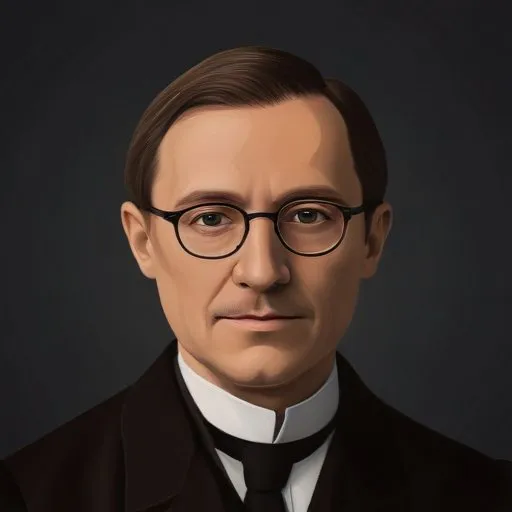
A 19th-century mathematician who made significant contributions to number theory, particularly in the development of the theory of elliptic functions. His work laid the foundation for later mathematicians like David Hilbert.
Carl Wilhelm Borchardt, a renowned German mathematician, is best known for his groundbreaking work on the arithmetic-geometric mean (AGM), a fundamental concept in number theory that has far-reaching implications in various fields of mathematics. His research built upon the foundations laid by mathematicians such as Gauss and Lagrange, and his contributions paved the way for significant advancements in mathematics.
Borchardt was born on February 22, 1817, in Berlin, Germany, to a Jewish family. His father, Moritz, was a respected merchant, and his mother, Emma Heilborn, came from a family of intellectuals. From a young age, Borchardt demonstrated a keen interest in mathematics, and his parents recognized his talent, providing him with private tutors, including Julius Plücker and Jakob Steiner.
Borchardt pursued his higher education at the University of Berlin, where he studied under the guidance of Lejeune Dirichlet, a prominent mathematician of the time. In 1839, he moved to the University of Königsberg, furthering his knowledge and skills in mathematics.
In 1848, Borchardt began teaching at the University of Berlin, where he would spend the majority of his academic career. His research focused on the AGM, and he made significant progress in this area, generalizing the results of Ernst Kummer on diagonalizing symmetric matrices using determinants and Sturm functions.
Borchardt's work on the AGM had a profound impact on various branches of mathematics, including algebra, geometry, and number theory. His research laid the foundation for future mathematicians to build upon, and his contributions continue to influence mathematical discoveries to this day.
In 1856, Borchardt became the editor of Crelle's Journal, a prestigious mathematical publication. During his tenure, the journal became known as "Borchardt's Journal," and it was a platform for mathematicians to share their research and ideas. Borchardt's editorial expertise and mathematical excellence helped establish the journal as a leading publication in the field.
Carl Wilhelm Borchardt's legacy extends beyond his mathematical contributions. He played a significant role in promoting mathematical research and education in Germany during the 19th century. His work inspired future generations of mathematicians, and his influence can be seen in various areas of mathematics.
Borchardt's grave is preserved in the Protestant Friedhof III der Jerusalems- und Neuen Kirchengemeinde Cemetery in Berlin-Kreuzberg, a testament to his enduring legacy in the world of mathematics.
Carl Wilhelm Borchardt's contributions to mathematics have left an indelible mark on the field, and his legacy continues to inspire mathematicians and researchers today.
Born in 1849
A pioneer in geometry and group theory, known for developing the Erlangen program, which unified various geometries under a single framework. His work laid foundations for modern algebraic geometry and topology.
Born in 1862
A renowned mathematician and academic who developed infinite-dimensional vector spaces and laid the foundation for quantum mechanics and relativity. He's also famous for his 23 unsolved math problems that shaped 20th-century mathematics.
Born in 1864
Developed groundbreaking geometric methods that transformed our understanding of space and time, and his work laid the foundation for Einstein's theory of relativity.
Born in 1777
A pioneer in mathematics and physics, he made major contributions to number theory, algebra, and electromagnetism, shaping our understanding of the natural world.
Born in 1826
A pioneering mathematician who developed the theory of higher dimensions and laid the foundations for modern physics, particularly in the understanding of space and time.
Born in 1831
Developed a rigorous definition of real numbers and introduced the concept of Dedekind cuts, revolutionizing mathematics and laying the foundation for modern analysis. His work also explored the nature of infinity and the foundations of mathematics.
Born in 1823
A pioneer in number theory, this mathematician developed the concept of ideals and contributed significantly to the development of modern algebra. Their work laid the foundation for many mathematical advancements.
Born in 1805
A German mathematician and academic who made significant contributions to number theory, particularly in the development of the Dirichlet's theorem, and was one of the first mathematicians to give lectures on the subject. He also worked on the theory of Fourier series and its applications.
