


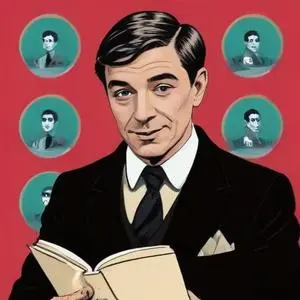
A renowned poet laureate and author of mystery novels, known for his vivid imagery and exploration of human nature, as well as his pseudonym Nicholas Blake.
Cecil Day-Lewis, often written as C. Day-Lewis, was a renowned Anglo-Irish poet and writer who served as the Poet Laureate of the United Kingdom from 1968 until his death in 1972. But what makes him even more intriguing is his secret life as a mystery writer, penning novels under the pseudonym Nicholas Blake.
Day-Lewis was born on April 27, 1904, in Ballintubbert, Athy-Stradbally border, Queens County, Ireland, to Frank Day-Lewis, a Church of Ireland rector, and Kathleen Blake (née Squires). His early life was marked by tragedy, with his mother passing away when he was just two years old. He was brought up in London by his father, with the help of an aunt, and spent summer holidays with relatives in County Wexford.
Day-Lewis's love for words was nurtured at Sherborne School and Wadham College, Oxford, where he became part of the circle gathered around W.H. Auden. He helped edit Oxford Poetry in 1927 and published his first collection of poems, Beechen Vigil, in 1925. This marked the beginning of a prolific career, with Day-Lewis going on to publish numerous poetry collections, plays, and novels.
In the 1930s, Day-Lewis began writing mystery novels under the pseudonym Nicholas Blake. This alter ego allowed him to explore the darker corners of his imagination, creating intricate plots and complex characters. His most famous creation is undoubtedly Nigel Strangeways, a gentleman detective who features in many of his novels.
Day-Lewis's work was widely acclaimed, earning him numerous awards and honors. He was appointed Commander of the Order of the British Empire (CBE) in 1951 and was knighted in 1968. He also received the Queen's Gold Medal for Poetry in 1960.
Day-Lewis married Constance Mary King in 1928, and they had two sons, Daniel Day-Lewis, the actor, and Tamasin Day-Lewis, a documentary filmmaker and television chef. His personal life was marked by a deep love for nature, music, and literature, which are all reflected in his work.
Today, Cecil Day-Lewis is remembered as a master of words, a weaver of intricate plots, and a poet who explored the human condition with sensitivity and nuance. His legacy continues to inspire generations of writers, poets, and mystery enthusiasts alike.
Born in 1907
A renowned poet, playwright, and composer who explored themes of love, morality, and social justice through his works, leaving a lasting impact on 20th-century literature.
Born in 1888
A renowned poet, playwright, and critic who reshaped modern poetry with works like "The Waste Land" and "Old Possum's Book of Practical Cats", influencing literature and art with their unique style.
Born in 1885
A pioneering modernist poet and critic who transformed 20th-century literature with innovative styles and provocative ideas, shaping the course of modern poetry.
Born in 1895
A renowned poet, novelist, and critic, best known for his historical novels, particularly "I, Claudius" and "Count Belisarius", which vividly brought ancient civilizations to life.
Born in 1907
A leading figure of the 1930s poetic movement, known for his lyrical and introspective verse that explored themes of love, nature, and the human condition.
Born in 1909
A prominent literary figure of the 20th century, known for his poetry and novels that explored themes of love, politics, and social justice. His work often reflected his experiences as a gay man and his involvement in left-wing politics.
Born in 1904
A celebrated author of novels and plays, known for his vivid portrayals of 1930s Berlin and his exploration of gay identity.
87 Years Old
A renowned Irish wordsmith celebrated for his evocative poetry and plays that explored the human experience, delving into themes of identity, culture, and the complexities of life. His lyrical works often echoed the rhythms of his native land.
