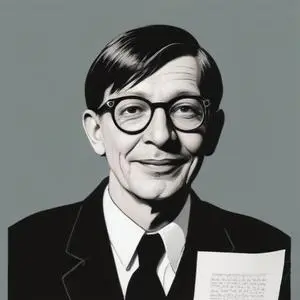
W. H. Auden: The Maverick Poet of the 20th Century
Audit of a Literary Genius
W. H. Auden, the British-American poet, is renowned for his stylistic and technical mastery in poetry, tackling a wide range of themes such as love, politics, morality, and religion. His work is a testament to his versatility, as he effortlessly navigates between different forms and tones, leaving an indelible mark on the literary world.
Early Life and Education
Born on February 21, 1907, in York, England, Auden grew up in a middle-class family and was educated at various prestigious independent schools. He then went on to study English at Christ Church, Oxford, where he honed his literary skills and developed a passion for poetry.
The Berlin Interlude and Teaching Years
After a brief stint in Berlin in 1928-1929, Auden spent five years teaching in British private preparatory schools from 1930 to 1935. This period not only refined his writing skills but also instilled in him a sense of discipline and responsibility.
Rise to Fame and Literary Contributions
Auden's first book,
Poems, published in 1930, catapulted him to fame, followed by
The Orators in 1932. His collaborative plays with
Christopher Isherwood between 1935 and 1938 solidified his reputation as a left-wing political writer. However, Auden's move to the United States in 1939 marked a shift in his focus towards religious themes, as seen in his long poems
For the Time Being and
The Sea and the Mirror.
Awards and Accolades
Auden's most notable achievement came in 1947 when he won the Pulitzer Prize for Poetry for his long poem
The Age of Anxiety, which also became a popular phrase describing the modern era. He was also appointed as the Professor of Poetry at Oxford from 1956 to 1961, where his lectures were highly acclaimed and later formed the basis of his 1962 prose collection
The Dyer's Hand.
Philosophical Contributions and Beliefs
Auden's poetry is characterized by its exploration of the human condition, delving into themes of love, morality, and religion. He believed that poetry should be a reflection of the human experience, rather than mere aesthetics. His philosophical contributions have had a profound impact on modern literature, inspiring generations of writers and poets.
Influence on Modern Society and Pop Culture
Auden's work has had a significant influence on modern society, with his poetry being referenced in various forms of media, including music, film, and literature. His phrase "The Age of Anxiety" has become a cultural touchstone, symbolizing the angst and uncertainty of the modern era.
Personal Milestones and Key Life Events
- 1928-1929: Spent time in Berlin, which had a profound impact on his writing
- 1930: Published his first book, Poems
- 1935-1938: Collaborated with Christopher Isherwood on three plays
- 1939: Moved to the United States, where he became an American citizen in 1946
- 1947: Won the Pulitzer Prize for Poetry for The Age of Anxiety
- 1956-1961: Served as Professor of Poetry at Oxford
Legacy and Historical Context
W. H. Auden's legacy extends far beyond his poetry, as he played a significant role in shaping the literary landscape of the 20th century. His work continues to be widely read and studied, offering a unique perspective on the human experience. As a testament to his enduring influence, Auden's poetry remains a timely and timeless reflection of our collective anxieties, hopes, and desires.
FAQ
What was W.H. Audens literary style and theme?
W.H. Auden was an English-American poet, playwright, and composer known for his complex and nuanced literary style, which often explored themes of love, morality, and politics.
What is W.H. Audens most famous poem?
W.H. Audens most famous poem is Funeral Blues, which has been widely anthologized and remains a popular classic.
What was W.H. Audens role in the literary movement of the 1930s?
W.H. Auden was a key figure in the literary movement of the 1930s, which sought to explore new forms of poetry and drama.
How did W.H. Audens personal experiences influence his writing?
W.H. Audens personal experiences, including his relationships and struggles, deeply influenced his writing, which often reflected his introspective and emotional nature.
What is W.H. Audens legacy in English literature?
W.H. Audens legacy in English literature is significant. He is considered one of the most important poets of the 20th century, and his work continues to inspire many writers and poets.