


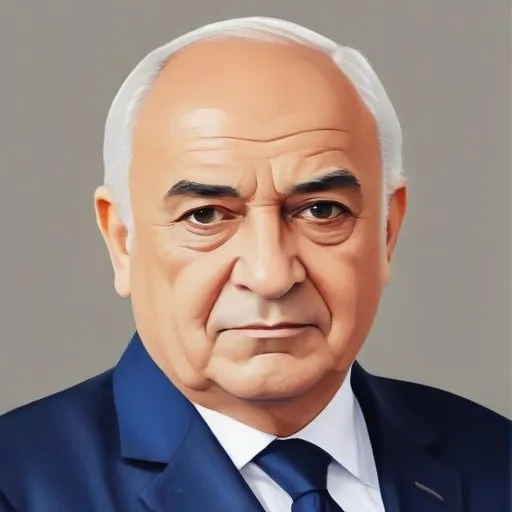
A Greek communist politician who served as the General Secretary of the Communist Party of Greece and played a significant role in the country's left-wing politics.
Charilaos Florakis, also known as Harilaos Florakis, was a prominent Greek communist leader who dominated the country's political scene for decades. He is best known for establishing the dominance of the Communist Party of Greece (KKE) over other left-wing elements and for his flexibility in forming alliances with conservatives.
Florakis was born on July 20, 1914, in the village of Paliozoglopi, near Agrafa in the Itamos municipality, Karditsa Prefecture, Greece. He was the fourth of six children. During World War II, he joined the Communist Party of Greece in 1941 and became an EAMELAS partisan, fighting against the Nazi occupation under the nom de guerre Yotis. He started as a captain and later rose to the rank of major.
Florakis fought on the losing side of the Greek Civil War that followed the liberation of Greece from Nazi occupation. He subsequently left the country, only to return in 1954. Upon his return, he was arrested and sentenced to life in prison.
During his 18 years in detention or jail, Florakis continued to play a prominent role in Greek politics. He was first elected to parliament in 1974, after the Metapolitefsi, and led the KKE as its general secretary from 1972 until 1989. Under his leadership, the KKE became a dominant force in Greek politics, and he formed alliances with conservatives to further the party's goals.
In 1989, Florakis stepped down as the general secretary of KKE and proposed Grigoris Farakos as his successor. However, he did not retire from politics. Instead, he became the president of the newly founded Synaspismos, or Coalition of the Left, which aimed to reconcile Greece's two main communist factions.
Throughout his life, Florakis had a profound impact on Greek politics. He played a key role in shaping the country's political landscape, and his leadership of the KKE and Synaspismos helped to galvanize the left-wing movement in Greece. Despite facing opposition and persecution, Florakis remained committed to his ideals and continued to fight for social justice and equality.
"The struggle for socialism is not a struggle for power, but a struggle for the dignity of the human being."
Florakis's life and legacy are a testament to his unwavering commitment to the principles of socialism and communism. Despite facing opposition and persecution, he remained committed to his ideals and continued to fight for social justice and equality. His impact on Greek politics and the global left-wing movement is still felt today.
Charilaos Florakis passed away on May 22, 2005, but his legacy continues to inspire generations of socialists and communists around the world.
52 Years Old
Greek engineer and politician who served as Prime Minister of Greece from 2015 to 2019, known for his efforts to restructure Greece's debt and implement progressive policies .
65 Years Old
A Greek economist and politician who served as Minister of Finance, known for his unorthodox views on economics and his role in the Greek debt crisis negotiations. He's a prominent critic of austerity measures and advocate for a more democratic European Union.
Born in 1883
A Greek philosopher, author, and playwright who explored the human condition through novels like "Zorba the Greek" and "The Last Temptation of Christ", delving into themes of spirituality, morality, and individualism.
Born in 1919
Greek economist and politician who served as Prime Minister of Greece, known for his socialist policies and efforts to reduce Greece's reliance on foreign capital. He also played a key role in Greece's accession to the European Union.
Born in 1888
A Greek lawyer, economist, and politician who served as the Prime Minister of Greece from 2009 to 2011, known for his efforts to address the country's debt crisis.
Born in 1907
A Greek lawyer and politician who served as President of Greece, known for leading the country's transition from military dictatorship to democracy. He's credited with modernizing Greece and joining the European Union.
Born in 1864
A Greek statesman who played a crucial role in shaping modern Greece, leading the country through significant reforms and transformations. He's known for his visionary leadership and diplomatic prowess.
Born in 1900
A Greek poet and diplomat who won the Nobel Prize in Literature in 1963 for his lyrical and symbolic poetry that explored Greek identity and culture. His work is known for its evocative and introspective style.
