


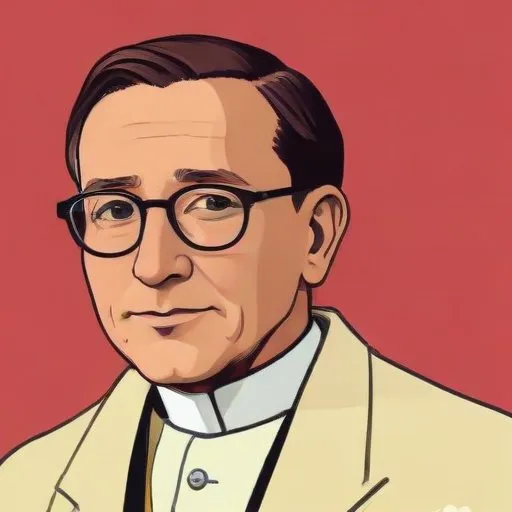
A controversial Catholic priest who used radio to promote anti-Semitic and isolationist views, gaining a massive following in the 1930s.
Known as the "Radio Priest," Charles Edward Coughlin was a Canadian-American Catholic priest who mesmerized millions with his weekly broadcasts, becoming one of the first political leaders to harness the power of radio to reach a mass audience. With an estimated 30 million listeners tuning in during the 1930s, Coughlin's influence extended far beyond the pulpit, shaping public opinion on politics, economics, and social justice.
Born on October 25, 1891, in Hamilton, Ontario, Canada, to working-class Irish Catholic parents, Coughlin was ordained to the priesthood in 1916. He served as a priest in various parishes before being assigned to the National Shrine of the Little Flower in Royal Oak, Michigan, in 1923.
As anti-Catholic sentiment grew in the 1920s, Coughlin began broadcasting his sermons to reach a wider audience. His charismatic style and persuasive oratory skills quickly gained popularity, earning him the nickname "The Radio Priest." His broadcasts tackled social and economic issues, resonating with millions struggling during the Great Depression.
In 1934, Coughlin founded the National Union for Social Justice, a political organization advocating for monetary reforms, nationalization of major industries and railroads, and protection of labor rights. With millions of members, the organization became a force to be reckoned with, although its local structure was poorly organized.
Coughlin's popularity was marred by accusations of anti-Semitism, as he began to target Jewish bankers and intellectuals in his broadcasts. He also expressed support for some policies of Nazi Germany and Fascist Italy, drawing criticism from the Roosevelt administration and the Catholic Church. His newspaper, Social Justice, was eventually shut down, and his radio program was forced off the airwaves in 1939.
Charles Coughlin's legacy is complex and multifaceted. While his advocacy for social justice and his innovative use of radio earned him widespread admiration, his anti-Semitic rhetoric and support for fascist regimes have been widely condemned. Nevertheless, his impact on American politics and society during the 1930s cannot be overstated, and his story serves as a cautionary tale about the dangers of demagoguery and the importance of responsible leadership.
Despite the controversy surrounding his later years, Charles Coughlin's legacy as a pioneering radio personality and social commentator continues to fascinate historians and scholars. His story serves as a reminder of the power of media to shape public opinion and the importance of responsible leadership in times of turmoil.
Born in 1882
Led the United States through the Great Depression and World War II, implementing a series of reforms known as the New Deal and helping to establish the country as a global superpower.
Born in 1915
An American naval aviator who flew combat missions in World War II, and was intended to be the first Kennedy to hold public office before his tragic death in a secret mission.
Born in 1863
Founded the pioneering automobile manufacturing company that revolutionized the industry with the assembly line production method, making cars more affordable and accessible to the masses.
Born in 1895
A charismatic Catholic television personality who preached to millions, promoting faith and morality through media, and was a pioneer in using television to spread religious messages.
Born in 1873
The 42nd Governor of New York was a prominent figure in American politics, known for being the first Catholic to run for President and a strong advocate for social justice and progressive reforms. He played a significant role in shaping the Democratic Party's platform during the 1920s and 1930s.
Born in 1897
A pioneering social activist and journalist who advocated for pacifism, women's rights, and the poor, founding the Catholic Worker Movement to promote social justice and nonviolence.
Born in 1855
A pioneering labor leader who fought for workers' rights and social justice, founding the Industrial Workers of the World and running for president five times on the Socialist Party ticket.
Born in 1893
A charismatic populist who dominated Louisiana politics in the 1920s and 1930s, known for his radical reforms and infamous "Share Our Wealth" program.
