


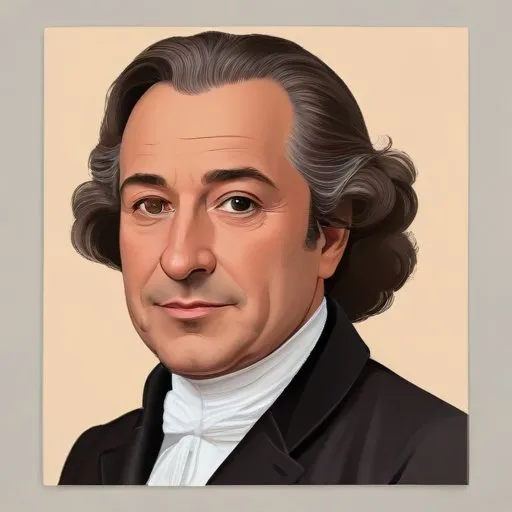
A French lawyer and politician who served as Napoleon's Chief Minister and played a key role in shaping the French Empire's administrative and judicial systems. He's most known for his efforts to centralize power and reform the French government.
Charles-François Lebrun, Duc de Plaisance, is best known for his instrumental role in shaping the course of the French Revolution, serving as the third Consul of France from 1799 to 1804, and later as the Arch-Treasurer of the Empire under Napoleon Bonaparte.
As a skilled politician and administrator, Lebrun played a crucial part in stabilizing the tumultuous French government during the late 18th century, earning him recognition as one of the most important figures of his time.
Born on March 19, 1739, in Dourdan, France, Lebrun was the son of a lawyer and received a solid education in law and literature. He went on to study law in Paris, eventually becoming a lawyer himself.
Lebrun's entry into politics began in 1779, when he was appointed as the procureur général of the Cour des Aides, a position that gave him significant influence in the French judicial system. His moderate views and strong administrative skills soon gained him recognition, and he was elected to the National Constituent Assembly in 1789.
As a member of the Assembly, Lebrun played a key role in drafting the Constitution of 1791, which aimed to establish a constitutional monarchy in France. His expertise in finance and economics also led to his appointment as the Minister of Finance in 1792.
In 1799, Lebrun was appointed as one of the three Consuls of France, alongside Napoleon Bonaparte and Roger Ducos. This marked the beginning of his most influential period, during which he worked closely with Napoleon to consolidate power and stabilize the country.
In 1804, Napoleon appointed Lebrun as the Arch-Treasurer of the Empire, a position that gave him control over the French treasury and economic affairs. Lebrun's financial acumen and diplomatic skills enabled him to navigate the complexities of European politics, securing vital alliances and funding for Napoleon's military campaigns.
Lebrun's personal life was marked by a strong sense of duty and loyalty. He married Anne Delagoutte in 1769, with whom he had three children. His dedication to his family was evident in his letters, which showcased his deep affection for his loved ones.
A devout Catholic, Lebrun was also known for his philosophical views, which emphasized the importance of morality, education, and social welfare. He believed in the power of education to shape the destiny of a nation and advocated for reforms that would improve the lives of the common people.
Charles-François Lebrun, Duc de Plaisance, left an indelible mark on French history. His statesmanship, administrative prowess, and financial expertise played a crucial role in stabilizing the French Revolution and laying the foundations for Napoleon's empire.
In the context of modern French history, Lebrun's contributions are often overshadowed by Napoleon's grandeur. However, his importance cannot be overstated, as he provided the intellectual and administrative backbone that enabled Napoleon's rise to power.
Lebrun's legacy extends beyond France, as his ideas on governance, finance, and education continue to influence policymakers and intellectuals around the world. His commitment to social welfare, morality, and education remains an inspiration to those seeking to create a better world.
As we reflect on the life and achievements of Charles-François Lebrun, Duc de Plaisance, we are reminded of the power of dedication, hard work, and vision in shaping the course of human history. His remarkable story serves as a testament to the enduring legacy of one of France's most iconic figures.
Born in 1769
A French military leader who rose to prominence during the French Revolution and became Emperor of France, known for his military conquests and reorganization of Europe. He is also famous for his Napoleonic Code, which remains a foundation of modern law.
Born in 1759
A French lawyer and politician who served as Minister of Police under Napoleon, notorious for his ruthless suppression of dissent and creation of a vast network of spies and informants.
Born in 1749
Developed nebular hypothesis of the origin of the solar system and formulated Laplace's equation, a fundamental concept in mathematics and physics. He's considered the founder of celestial mechanics.
Born in 1769
A skilled military strategist and one of Napoleon's most trusted generals, known for his bravery and tactical genius on the battlefield.
Born in 1758
A skilled military strategist and one of Napoleon's most trusted generals, known for his victories in the Peninsular War and his role in shaping modern warfare.
Born in 1753
A skilled military strategist and Napoleon's chief of staff, he played a crucial role in many French military victories and was later appointed Minister of Defence. He's known for his exceptional organizational skills and ability to coordinate large-scale military operations.
Born in 1767
A flamboyant and daring cavalry commander who played a key role in Napoleon's military conquests, earning the title of King of Naples.
