


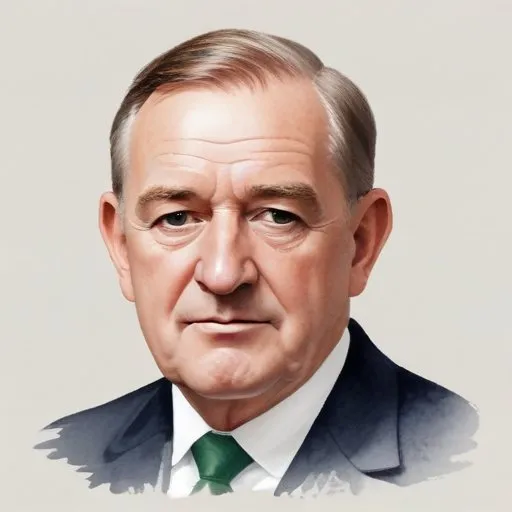
An Irish-Australian politician who served as the 8th Premier of Victoria, known for his role in shaping the colony's early development and infrastructure. He was a key figure in Australian politics during the mid-19th century.
Sir Charles Gavan Duffy, KCMG, PC, was a multifaceted Irish poet, journalist, and politician who left an indelible mark on the world of literature and politics. As the editor of The Nation, he played a pivotal role in shaping Ireland's fight for independence, and later, as the Premier of Victoria, Australia, he championed land reform and paved the way for a more just society.
Born on April 12, 1816, in Monaghan Town, County Monaghan, Ireland, Duffy grew up in a Catholic family and was educated in Belfast at St Malachy's College and the Royal Belfast Academical Institution. His early life was marked by tragedy when his father passed away when he was just 10 years old.
It was during this time that Duffy met Charles Hamilton Teeling, a United Irish veteran of the 1798 rising, who inspired him to take up writing. Teeling's recollections of '98 sparked Duffy's interest in literature and politics, and he soon began contributing to Teeling's journal, The Northern Herald.
In 1843, Duffy published Ballad Poetry of Ireland, which cemented his reputation as a poet and literary critic. He went on to edit The Vindicator, an O'Connellite journal, and later co-founded The Nation with Thomas Osborne Davis and John Blake Dillon in 1842.
The Nation became a powerful platform for Irish nationalism, featuring contributions from notable writers, including Jane Wilde, Margaret Callan, John Mitchel, John Edward Pigot, and William Smith O'Brien. Duffy's editorship of the journal solidified his position as a leading voice in Ireland's fight for independence.
In 1856, Duffy emigrated to Australia, settling in Victoria, where he entered the political arena. He advocated for land reform and became a champion of tenant rights, eventually serving as the colony's 8th Premier from 1871 to 1872.
Duffy's commitment to social justice and his vision for a more equitable society earned him widespread respect and admiration in Victoria. His legacy as a champion of land reform and tenant rights continues to inspire politicians and social activists to this day.
Sir Charles Gavan Duffy's contributions to Irish literature and politics are immeasurable. His commitment to social justice and his tireless advocacy for tenant rights have left an enduring impact on Ireland and Australia. As a poet, journalist, and politician, Duffy embodied the values of compassion, justice, and equality, inspiring generations to come.
Today, Duffy's legacy serves as a reminder of the power of literature and politics to shape our world and create a more just society for all.
Born in 1815
A pioneering figure in Australian politics, instrumental in shaping the country's federation and unity, known for his tireless advocacy for a unified Australia.
Born in 1856
The 2nd Prime Minister of Australia, a key figure in the country's early development, known for his role in shaping Australia's constitution and federation. He played a crucial part in uniting the country's six colonies into a single nation.
Born in 1849
Australia's first Prime Minister, who played a key role in the country's federation and shaped its early government, is most known for uniting the country's six colonies into one nation. He was a strong advocate for Australian independence and self-governance.
Born in 1845
The 4th Prime Minister of Australia, a Scottish-Australian lawyer and politician who served from 1904 to 1905, known for his role in shaping the country's early years and contributing to its growth.
Born in 1867
Third Prime Minister of Australia, serving from 1904 to 1905, known for his efforts to establish a national government and implement progressive reforms.
Born in 1862
The 5th Prime Minister of Australia, a key figure in the country's early 20th-century politics, known for his role in shaping Australia's social and economic landscape. He played a crucial part in establishing the country's old-age pension and maternity allowance systems.
Born in 1876
The 9th Prime Minister of Australia, serving from 1929 to 1932, is known for leading the country through the Great Depression and implementing significant economic reforms. He was a strong advocate for workers' rights and social justice.
Born in 1885
Led the country through World War II, implementing policies to defend Australia and its economy. He's also known for his leadership during the country's transition from British to American influence.
