


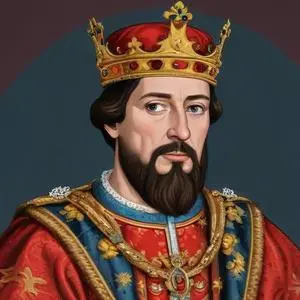
The King of Bohemia who united the warring states of Germany and issued the Golden Bull, a decree that established the rules for electing the Holy Roman Emperor. He strengthened the empire and promoted education and arts.
Charles IV, also known as Charles of Luxembourg, is revered as one of the most influential figures in European history, leaving an indelible mark on the politics, culture, and architecture of the Holy Roman Empire. He is best known for his remarkable reign as King of Bohemia, King of the Romans, and ultimately, Holy Roman Emperor, from 1355 until his death in 1378.
Born Wenceslaus on May 14, 1316, Charles was the eldest son of John of Bohemia, King of Bohemia and Count of Luxembourg. His mother, Elizabeth, Queen of Bohemia, was the sister of Wenceslaus III, King of Bohemia and Poland, making Charles a member of the House of Luxembourg and the Bohemian House of Pemyslid.
Charles inherited the County of Luxembourg from his father and was elected King of Bohemia in 1346. He was crowned on September 2, 1347, and shortly after, on July 11, 1346, the prince-electors chose him as King of the Romans, in opposition to Louis IV, Holy Roman Emperor. Charles was crowned on November 26, 1346, in Bonn, and after his opponent's death, he was re-elected in 1349 and crowned King of the Romans.
Charles's coronation as King of Italy in 1355 marked the beginning of his reign as Holy Roman Emperor. He proceeded to solidify his position by becoming the personal ruler of all the kingdoms of the Holy Roman Empire with his coronation as King of Burgundy in 1365.
One of Charles's most notable achievements was the issuance of the Golden Bull of 1356, a seminal document that introduced significant structural changes to the politics of the Holy Roman Empire. This edict established the seven prince-electors, granted them significant powers, and solidified the electoral process for the position of Holy Roman Emperor.
Charles was a patron of the arts and architecture, commissioning numerous projects that transformed the urban landscape of Prague, the capital of Bohemia. He founded the Charles University in Prague, which became a hub of learning and intellectual inquiry.
His most enduring architectural legacy is the Charles Bridge, a magnificent structure that spans the Vltava River and connects the Lesser Town district with the Old Town. The bridge, lined with statues of saints and nobles, has become an iconic symbol of Prague and a testament to Charles's vision for the city.
Charles was married four times, with his first marriage to Blanche of Valois producing no children. His subsequent marriages to Anna of the Palatinate, Anna of Świdnica, and Elizabeth of Pomerania yielded numerous children, including sons Wenceslaus and Sigismund, who would go on to play important roles in European politics.
Charles's reign was not without controversy, with some historians criticizing his authoritarian tendencies and consolidation of power. His treatment of the Bohemian nobility and his role in the suppression of the Slavic tribes have also been subjects of debate.
Despite these criticisms, Charles IV's impact on European history is undeniable. His administrative reforms, architectural projects, and cultural patronage have left a lasting legacy that continues to shape the region today. He remains a celebrated figure in the Czech Republic, a testament to his enduring influence on the politics, culture, and identity of the region.
Born in 1649
Head of the Catholic Church from 1700 to 1721, known for resolving the Jansenist controversy and promoting the arts, particularly music and architecture.
Born in 1611
Led the Catholic Church during a tumultuous period, reforming the Church's finances and combating corruption, while also opposing the French monarch's attempts to exert control over the Church.
