


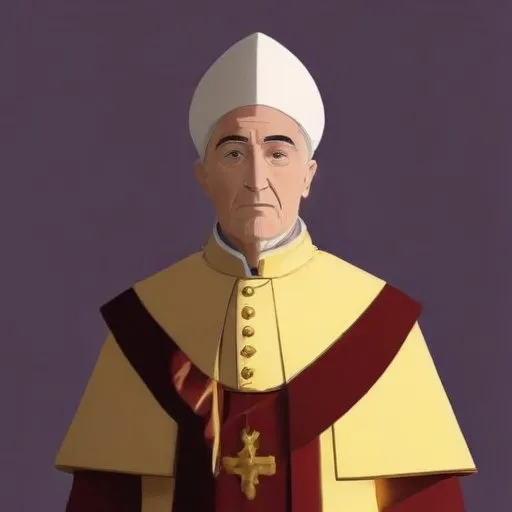
Head of the Catholic Church from 1700 to 1721, known for resolving the Jansenist controversy and promoting the arts, particularly music and architecture.
Pope Clement XI, born Giovanni Francesco Albani, was a renowned patron of the arts and sciences, who reigned as the head of the Catholic Church and ruler of the Papal States from 1700 to 1721. He is particularly known for his significant contributions to the preservation of Rome's antiquity, funding expeditions to rediscover ancient Christian writings, and authorizing excavations of the Roman catacombs.
Giovanni Francesco Albani was born in 1649 in Urbino, Italy, to the distinguished Albani family of Albanian origin. His mother, Elena Mosca, was of high standing and descended from the noble Mosca family of Pesaro. Albani's education was steeped in the classics, studying at the Collegio Romano in Rome from 1660 onwards, where he became an accomplished Latinist and earned a doctorate in both canon and civil law.
Albani's intellectual prowess and loyalty to the Catholic Church earned him the respect of Pope Alexander VIII, who elevated him to the cardinalate in 1690. He served as a papal prelate under Pope Alexander VIII and later as the Referendary of the Apostolic Signatura under Pope Innocent XII. Additionally, he held governorships in Rieti, Sabina, and Orvieto.
On November 23, 1700, Albani was elected as Pope Clement XI, succeeding Pope Innocent XII. During his papacy, he continued to support the arts and sciences, commissioning works from renowned artists and architects. His interest in archaeology led to the discovery of many ancient artifacts, which he helped to preserve and protect.
In addition to his papal duties, Pope Clement XI was a man of curiosity and inquiry. He funded an expedition to Albania to locate the exact settlement of his family's origins, demonstrating his commitment to understanding his own heritage.
Pope Clement XI's legacy extends beyond the Catholic Church, inspiring future generations of scholars, artists, and archaeologists. His contributions to the preservation of Rome's antiquity have had a lasting impact on our understanding of ancient civilizations.
Throughout his papacy, Pope Clement XI remained committed to the ideals of the Catholic Church, promoting a deep respect for tradition and a passion for knowledge. His patronage of the arts and sciences reflects his belief in the importance of humanism and intellectual curiosity.
| Year | Event |
|---|---|
| 1649 | Born in Urbino, Italy |
| 1660 | Began studies at the Collegio Romano in Rome |
| 1690 | Elevated to the cardinalate by Pope Alexander VIII |
| 1700 | Elected as Pope Clement XI |
| 1721 | Died on March 19 |
Pope Clement XI's remarkable life and legacy serve as a testament to the power of humanism, intellectual curiosity, and dedication to the preservation of our cultural heritage.
Born in 1611
Led the Catholic Church during a tumultuous period, reforming the Church's finances and combating corruption, while also opposing the French monarch's attempts to exert control over the Church.
Born in 1652
The 18th-century Pope who banned Freemasonry and reformed the Roman Curia, leaving a lasting impact on the Catholic Church's governance and relations with secret societies.
Born in 1650
A Dominican friar who played a key role in the Western Schism, issuing several bulls to assert his authority and legitimacy as the true pope. He's also known for his reforms and attempts to restore the church's discipline.
Born in 1675
A 18th-century pope who reformed the Catholic Church, promoting tolerance and scholarship, and is known for his encyclicals on topics like usury and the sacraments.
Born in 1536
Led the Catholic Church during a tumultuous period, issuing papal bulls and playing a key role in the Counter-Reformation. He's also famous for his coffee habit, being the first Pope to try and approve of it.
Born in 1675
A 18th-century pope who reformed the Catholic Church, promoting tolerance and scholarship, and is known for his encyclicals on topics like usury and the sacraments.
Born in 1504
Leader of the Catholic Church during the Counter-Reformation, he excommunicated Queen Elizabeth I and played a key role in the Council of Trent.
Born in 1876
The leader of the Catholic Church from 1939 to 1958, known for his controversial role during World War II, particularly in regards to the Holocaust. He is also remembered for his encyclicals on social justice and liturgical reforms.
