


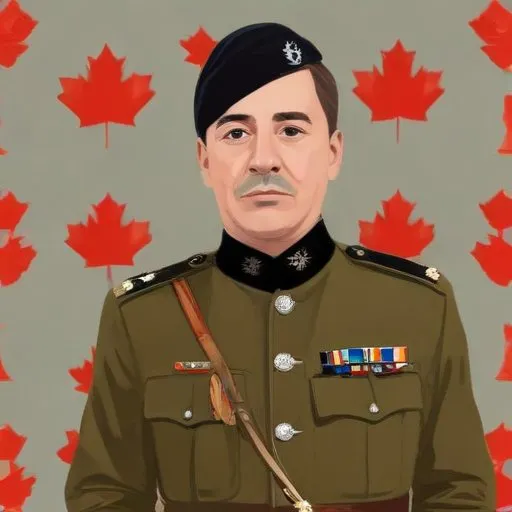
A Canadian colonel and politician, awarded the Victoria Cross for bravery during World War I, known for his heroic actions in the Battle of Hill 70. He later served as a member of the Canadian Parliament.
Charles Cecil Ingersoll Merritt is renowned for being one of the most decorated Canadian soldiers of World War II, earning the esteemed Victoria Cross for his extraordinary bravery and inspirational leadership during the infamous Dieppe Raid in 1942.
This distinguished honor is a testament to Merritt's unwavering commitment to his country and his unrelenting spirit in the face of overwhelming adversity, making him a true hero and an icon of Canadian military history.
Born on November 10, 1908, in Vancouver, British Columbia, Merritt was the son of Captain Cecil Mack Merritt, who made the ultimate sacrifice in the Second Battle of Ypres in 1915.
Merritt's academic pursuits took him to the Royal Military College of Canada, where he graduated with honors in 1925. He went on to read for the Bar and became a barrister in 1932, practicing law in Vancouver until the outbreak of World War II.
Commissioned into the Seaforth Highlanders of Canada in 1929, Merritt served with distinction throughout the war, holding various staff and regimental appointments.
In March 1942, he was promoted to command The South Saskatchewan Regiment, which was tasked with participating in the Dieppe Raid, a critical Allied operation aimed at disrupting German coastal defenses.
On August 19, 1942, Merritt led his regiment with unwavering courage and tactical prowess, despite being wounded twice in the battle. His selflessness, leadership, and bravery in the face of overwhelming odds earned him the Victoria Cross, the highest honor for valor in the face of the enemy.
After the war, Merritt returned to Canada and pursued a career in politics, becoming a Member of Parliament in 1945.
Throughout his life, Merritt remained committed to his country and his community, serving as a strong advocate for veterans' rights and welfare.
Charles Merritt's inspiring story serves as a beacon of courage, resilience, and dedication, leaving an indelible mark on Canadian history and inspiring generations to come.
Charles Merritt's legacy extends far beyond his military service, inspiring a nation with his bravery, leadership, and commitment to public service.
Today, his story serves as a powerful reminder of the importance of sacrifice, duty, and honor, continuing to inspire generations of Canadians and people around the world.
Born in 1871
Prolific writer of historical novels and adventure stories, also a talented landscape painter.
Born in 1865
The second monarch of the House of Windsor, reigning from 1910 to 1936, known for leading the British Empire through World War I and modernizing the monarchy.
Born in 1895
The 13th Prime Minister of Canada, a champion of individual rights and freedoms, introduced the Canadian Bill of Rights, a precursor to the Charter of Rights and Freedoms. He's also known for his anti-apartheid stance and leadership during the Suez Crisis.
Born in 1897
A Canadian leader who served as Prime Minister and won the Nobel Peace Prize for resolving the Suez Canal Crisis, known for his diplomatic efforts and peacekeeping initiatives.
Born in 1882
The 12th Prime Minister of Canada, a strong leader who played a crucial role in shaping the country's post-war economy and foreign policy, and is credited with establishing universal hospital insurance and old-age pensions.
Born in 1874
The tenth Prime Minister of Canada, serving for a record 22 years, is most known for leading the country through significant periods of economic and social change, including the Great Depression and World War II.
Born in 1875
Led Canada's military to significant victories in World War I, earning recognition as one of the greatest generals of the war. He modernized Canada's military tactics and played a crucial role in shaping the country's identity.
