


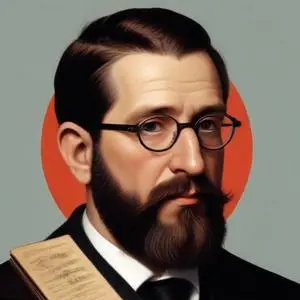
A pioneer in logic, semiotics, and pragmatism, he developed a comprehensive philosophical system and made significant contributions to the development of modern logic and statistics.
Charles Sanders Peirce was an American polymath who made significant contributions to various fields, earning him the title of "the most original and versatile of America's philosophers" and "America's greatest logician." He is best known for developing the philosophical school of pragmatism, which emphasizes the importance of practical application and experience in understanding truth and knowledge.
Peirce was born on September 10, 1839, in Cambridge, Massachusetts, to a family of intellectuals. His father, Benjamin Peirce, was a Harvard University professor of astronomy and mathematics. Charles Peirce studied chemistry at Harvard, graduating in 1859, and later worked as a scientist for the United States Coast Survey.
Peirce's work in logic and philosophy led to several groundbreaking contributions, including:
Peirce's philosophical views were shaped by his commitment to:
Peirce's ideas have had a significant impact on various fields, including:
Despite his significant contributions, Peirce's personal life was marked by financial struggles and controversy. He died on April 19, 1914, at the age of 74, leaving behind a legacy of innovative ideas and a profound impact on the development of modern philosophy and science.
Today, Peirce is recognized as one of the most important American philosophers of the late 19th and early 20th centuries, with his ideas continuing to influence fields as diverse as computer science, philosophy, and statistics.
Born in 1842
Pioneering philosopher and psychologist who explored the nature of consciousness, free will, and religious experience, and is known for his pragmatic approach to philosophy and psychology.
Born in 1859
Developed pragmatic philosophy and progressive education theories, focusing on hands-on learning and social reform. Known for his influential ideas on democracy, education, and individual freedom.
Born in 1872
A renowned thinker who made significant contributions to mathematics, philosophy, and social commentary, known for his influential writings on logic, ethics, and politics. He's a prominent figure in shaping modern intellectual thought.
Born in 1889
A philosopher who challenged traditional philosophy by emphasizing the importance of language and its limits, and is famous for his philosophical ideas on logic, reality, and the nature of meaning.
Born in 1889
A German philosopher and academic who explored the meaning of existence, time, and human existence, influencing 20th-century philosophy with his concept of "Being-in-the-world".
Born in 1848
Developed a formal system of logic and introduced modern mathematical notation, laying the groundwork for modern logic, mathematics, and computer science.
Born in 1874
A philosopher who developed the concept of "symbolic forms" to understand human culture and knowledge, and is known for his work on the philosophy of science and the Enlightenment.
Born in 1724
Developed influential philosophical frameworks, such as the Critique of Pure Reason, that shaped modern Western thought on ethics, morality, and human understanding.
