


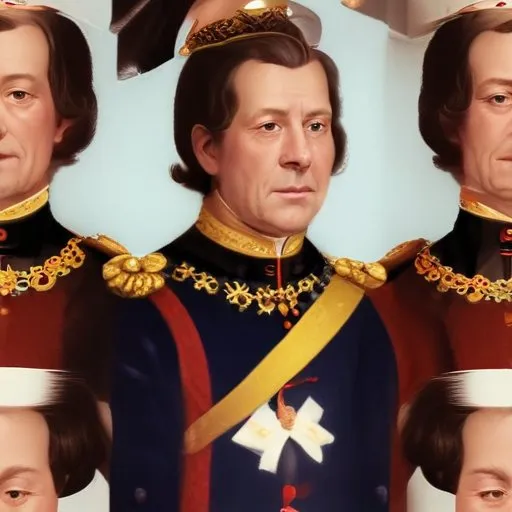
King of Sweden from 1660 to 1697, known for his military campaigns and domestic reforms that strengthened the Swedish monarchy.
Charles XI, also known as Carl, is renowned for his remarkable reign as the King of Sweden from 1660 to 1697, a period marked by significant reforms, military victories, and the consolidation of the Swedish Empire. During his 37-year reign, Charles XI transformed Sweden into a powerful and stable nation, earning him a reputation as one of the most successful monarchs in Swedish history.
Born on November 24, 1655, in the Stockholm Palace Tre Kronor, Charles XI was the only son of King Charles X Gustav of Sweden and Hedwig Eleonora of Holstein-Gottorp. Following his father's death in 1660, Charles XI ascended to the throne at the tender age of four, with the country being governed by regents until he came of age.
In 1675, Charles XI led his first military campaign, successfully defending Sweden against the Danish invasion in the Scanian War. This victory marked the beginning of his military prowess, and he went on to secure Sweden's borders, acquiring new territories and strengthening the country's position in Europe.
Upon his return to Stockholm, Charles XI focused on addressing the country's internal issues, introducing numerous reforms that transformed Sweden's political, financial, and economic landscape. Some of his notable achievements include:
Charles XI died on April 5, 1697, leaving behind a legacy of stability and prosperity. He was succeeded by his only son, Charles XII, who would go on to lead Sweden into a series of military campaigns, using the strong foundation established by his father.
Did you know that Charles XI was not actually the 11th King Charles of Sweden? The numbering tradition was started by his great-grandfather, King Charles IX, who adopted his own numeral based on a mythical history of Sweden.
Charles XI's reign is often referred to as the "Golden Age" of the Swedish Empire, a testament to his remarkable achievements and lasting impact on Swedish history.
Born in 1829
King of Sweden and Norway from 1872 to 1907, known for his diplomatic efforts to maintain Scandinavian unity and neutrality during the tumultuous late 19th century.
Born in 1748
King of Sweden and Norway from 1809 to 1818, known for his role in the Finnish War and the Convention of Moss, which led to the union of Sweden and Norway.
Born in 1746
King of Sweden from 1771 to 1792, known for his cultural and artistic achievements, and his assassination at a masquerade ball. He was a patron of the arts and a strong leader who modernized Sweden's government and economy.
Born in 1829
King of Sweden and Norway from 1872 to 1907, known for his diplomatic efforts to maintain Scandinavian unity and neutrality during the tumultuous late 19th century.
