


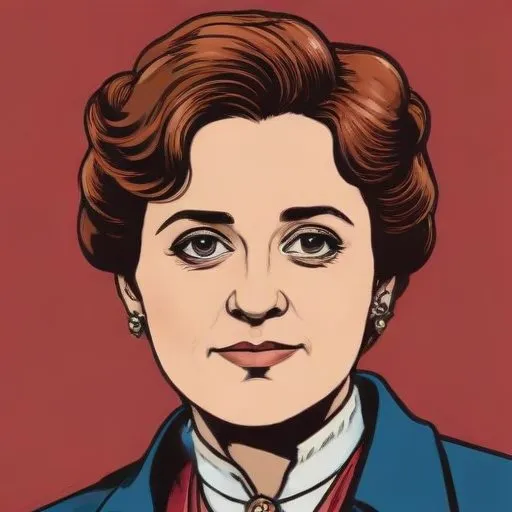
Pioneering mathematician and social activist who broke gender barriers in academia and advocated for women's rights and education. Her work paved the way for future generations of women in STEM fields.
Charlotte Barnum, born on May 17, 1860, was a pioneering mathematician and social activist who made history by becoming the first woman to receive a Ph.D. in mathematics from Yale University. This remarkable achievement paved the way for women in the field of mathematics and beyond.
Born in Phillipston, Massachusetts, Charlotte was the third of four children of Reverend Samuel Weed Barnum and Charlotte Betts Barnum. Education was highly valued in her family, with her uncles and brothers graduating from Yale University. Charlotte's own educational journey began at Hillhouse High School in New Haven, Connecticut, followed by Vassar College, where she graduated in 1881.
After teaching at a boys' preparatory school and Hillhouse High School, Charlotte worked as a computing assistant at the Yale Observatory from 1883 to 1885. During this period, she contributed to the revision of James Dwight Dana's System of Mineralogy. In 1886, she became an editorial writer for Webster's International Dictionary, a role she held until 1890. She then taught astronomy at Smith College for a year.
In 1890, Charlotte applied to Johns Hopkins University for graduate studies, only to be rejected due to her gender. Undeterred, she sought the support of Simon Newcomb, a professor of mathematics and astronomy, and was allowed to attend lectures without enrollment or charge. Two years later, she moved to New Haven to pursue her graduate studies at Yale University, where she earned her Ph.D. in mathematics in 1895.
Her thesis, titled "Functions Having Lines or Surfaces of Discontinuity," marked a significant milestone in her career. Although the identity of her adviser remains unclear, her achievement paved the way for future generations of women in mathematics.
Throughout her career, Charlotte demonstrated a strong commitment to social activism, particularly in her advocacy for women's education and empowerment. Her work and achievements served as a testament to the importance of equal opportunities for women in academia and beyond.
Charlotte Barnum's pioneering spirit and achievements have inspired generations of women in mathematics and beyond. Her legacy serves as a reminder of the importance of equal opportunities and the power of perseverance in the face of adversity.
In conclusion, Charlotte Barnum's remarkable life and achievements continue to inspire and empower individuals to pursue their passions, regardless of gender or social barriers. Her trailblazing spirit and commitment to social activism have left an indelible mark on the world of mathematics and beyond.
Born in 1882
A pioneering mathematician and physicist who revolutionized abstract algebra and made groundbreaking contributions to modern physics, particularly in the development of Einstein's theory of general relativity.
Born in 1776
A pioneering female mathematician and physicist who made significant contributions to number theory and elasticity theory, particularly in the study of prime numbers and Fermat's Last Theorem.
Born in 1901
A pioneering anthropologist and author who studied and wrote about diverse cultures, shedding light on human behavior and societal norms. Her groundbreaking work continues to influence modern anthropology and beyond.
Born in 1924
One of the first African-American women to earn a PhD in mathematics, she made significant contributions to computer science and academia, paving the way for future generations of women in STEM.
Born in 1780
A pioneering female mathematician and astronomer who wrote influential books on celestial mechanics and was one of the first women to be recognized for her scientific contributions. Her work helped popularize complex scientific concepts for a broader audience.
Born in 1815
Pioneering mathematician and computer scientist who wrote the first algorithm intended to be processed by a machine, and is often considered the first computer programmer. Her work on Charles Babbage's Analytical Engine envisioned its potential to go beyond mere calculation and perform any task that could be expressed in a series of steps.
