


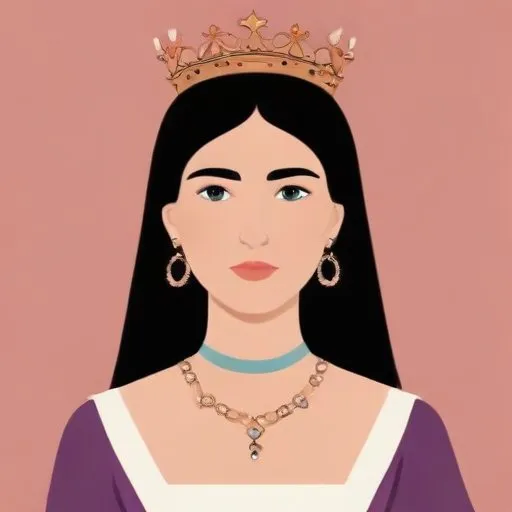
The last ruling monarch of the Kingdom of Cyprus, she was a strong-willed queen who fought to maintain her kingdom's independence from the Genoese and Venetian republics. She's known for her bravery and diplomatic efforts to preserve her kingdom.
Charlotte, Queen of Cyprus, is remembered for her courageous, yet ultimately futile, fight to maintain her claim to the Cypriot throne in the face of opposition from her illegitimate half-brother, James. Her tumultuous reign, marked by power struggles and military defeats, has become a testament to her unyielding spirit and determination.
Charlotte was born on June 28, 1444, in Nicosia, Cyprus, to King John II of Cyprus and Helena Palaiologina. As the eldest and only surviving daughter, she was groomed from a young age to assume the throne, with her younger sister Cleopha's death in 1448 cementing her position as sole legitimate heir.
In 1456, Charlotte was named Princess of Antioch, and shortly after, she married her first husband, John of Portugal. Following his death in 1457, her father's passing in 1458 led to her coronation as Queen of Cyprus at the tender age of 14. Her crowning at St. Sophia Cathedral on October 7, 1458, marked the beginning of a reign that would be beset by challenges to her authority.
Charlotte's illegitimate half-brother, James, born to her father's Greek mistress Marietta de Patras, posed a significant threat to her claim to the throne. With the support of the Egyptians, James eventually forced Charlotte to flee Cyprus in 1463, and he was subsequently crowned king.
In an attempt to reclaim her throne, Charlotte launched a military campaign, but was ultimately unsuccessful. Her defeat marked the end of her reign, and she spent the remainder of her life in exile, eventually dying childless in Rome in 1487.
Charlotte was raised in the Byzantine tradition, and her education was heavily influenced by her mother, Helena Palaiologina. She was fluent in Greek, and could write French, Italian, and possibly Latin. Her outspoken nature earned her the nickname "the Greek torrent" from Pope Pius II.
Charlotte's reign, although marked by turmoil and defeat, serves as a testament to her unwavering commitment to her claim to the throne. Her story is a powerful reminder of the challenges faced by women in positions of power during the medieval period.
In comparison to other female rulers of her time, Charlotte's determination to assert her authority in the face of opposition sets her apart. Her legacy serves as a powerful counterpoint to the more successful reigns of contemporaries such as Isabella of Castile and Margaret of Anjou.
Born in 1328
King of Cyprus who ruled from 1359 to 1369 and is known for his military campaigns and attempts to reclaim the Holy Land from the Muslims. He was also a patron of the arts and literature.
Born in 1418
King of Cyprus, Armenia, and Jerusalem, ruling from 1432 to 1458, known for his reign during a time of significant cultural and economic development in the region.
Born in 1476
French regent who governed France during her son's minority, playing a crucial role in shaping the country's politics and economy during the Italian Wars. She's also known for her patronage of the arts and humanism.
Born in 1380
Unified the Crown of Aragon, ruling over a vast territory in eastern Spain, and sponsored the voyages of Christopher Columbus, leading to the discovery of the New World.
Born in 1451
Unified the Spanish kingdoms, sponsored Christopher Columbus's voyage to the Americas, and established the Spanish Inquisition.
