


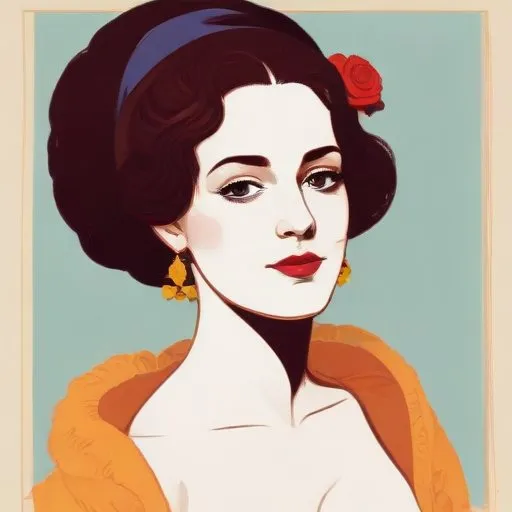
A 17th-century courtesan who captivated the French monarchy with her beauty and wit, becoming a mistress to King Henry IV and influencing royal politics.
Charlotte de Sauve, Viscountess of Tours, Baroness de Sauve, and Marquise de Noirmoutier, was a French noblewoman and courtesan who played a significant role in the royal courts of 16th-century France. She is best known for being a mistress of King Henry of Navarre, who would later become King Henry IV of France, and for being a member of Queen Mother Catherine de Medici's notorious "Flying Squadron," a group of beautiful female spies and informants.
Born on October 26, 1551, Charlotte was the daughter of Jacques de Beaune, Baron Semblanay, Viscount of Tours, and Gabrielle de Sade, a descendant of Provençal nobility. Her family's seat was in the former province of Touraine. Charlotte's early life was marked by tragedy, as her great-grandfather, Jacques de Beaune, was executed in 1527 at the instigation of Louise of Savoy.
Charlotte was sent to court, where she was educated in the household of Catherine de Medici. She quickly became known for her intelligence, beauty, and cunning, earning her a place in the Queen Mother's inner circle. In 1569, at the age of 18, Charlotte was married to Simon de Fizes, Baron de Sauve, secretary of state to King Charles IX and later King Henry III. The marriage was arranged by the powerful Guise family.
Charlotte's association with Catherine de Medici's "Flying Squadron" made her a key player in the intricate web of politics and espionage that characterized the French royal court. The Squadron, comprised of beautiful and intelligent women, was tasked with seducing important men at court and extracting information to pass on to the Queen Mother. Charlotte's skills in politics and her connections to the royal family made her an invaluable asset to the Squadron.
Charlotte's relationship with King Henry of Navarre, who would later become King Henry IV of France, is a significant part of her legacy. The exact nature of their relationship remains unclear, but it is known that Charlotte was one of the king's many mistresses. Her influence over the king and her role in the royal court were likely significant, given her connections to Catherine de Medici and her own family's status.
Charlotte succeeded her father to the barony of Semblanay and the viscounty of Tours. She played an active role in the pageants and ballets produced by Catherine de Medici, showcasing her beauty and charm to the French court. Despite her controversial reputation, Charlotte remains an important figure in French history, symbolizing the complex and often treacherous world of royal politics and intrigue.
While few direct quotes from Charlotte de Sauve exist, her contemporaries often described her as intelligent, beautiful, and cunning. Historian Jean Heritier noted that by the age of 21, Charlotte "knew all there was to be known about politics."
Charlotte de Sauve's life and legacy are inextricably linked to the tumultuous era of 16th-century France, marked by religious wars, royal intrigue, and shifting power dynamics. Her association with Catherine de Medici and King Henry IV of France cements her place as a key figure in this period, one whose influence extended far beyond the borders of the royal court.
Born in 1721
The influential royal mistress who dominated the French court with her beauty, wit, and politics, shaping the country's art, fashion, and culture. She was a patron of the arts and a trendsetter in 18th-century Europe.
Born in 1743
The last mistress of Louis XV, known for her lavish lifestyle, extravagant fashion sense, and significant influence on the king's decisions, ultimately leading to her downfall during the French Revolution.
Born in 1712
A pioneering thinker who shaped modern democracy and education with his ideas on social contracts, general will, and the importance of early childhood education. His writings influenced the French Revolution and modern political thought.
Born in 1694
A witty and insightful 18th-century writer and philosopher who used satire to critique societal norms and advocate for reason, tolerance, and human rights.
Born in 1703
A prominent artist of the Rococo style, known for his delicate and ornate paintings, often depicting mythological and pastoral scenes, as well as designing sets for the Paris Opera.
