


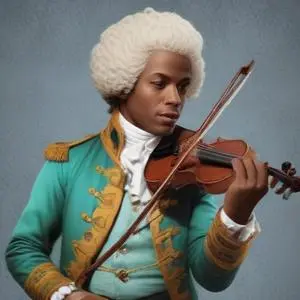
A Caribbean-French virtuoso who excelled as a violinist, composer, and conductor, leaving an indelible mark on classical music with his innovative and eclectic style. He broke racial barriers, becoming the first person of color to lead a major European orchestra.
As the first classical composer of African descent to attain widespread acclaim in European music, Chevalier de SaintGeorges left an indelible mark on the world of classical music. This multifaceted virtuoso was a violinist, conductor, composer, soldier, fencer, athlete, and accomplished dancer, who excelled in various fields and defied the societal norms of his time.
Born on December 25, 1745, in the French colony of Guadeloupe, SaintGeorges was the son of a wealthy plantation owner, Georges Bologne de SaintGeorges, and one of his enslaved Creole women. This unique background did not hinder his rise to fame, as he went on to become a celebrated musician, respected for his innovative compositions and exceptional violin skills.
At the tender age of seven, SaintGeorges was taken to France, where he began his formal education. He received music and musical composition lessons, which laid the foundation for his future success. In 1773, he joined the orchestra Le Concert des Amateurs, and his exceptional talent earned him the appointment as its conductor.
SaintGeorges' compositional repertoire includes violin concertos, string quartets, sinfonia concertantes, violin duets, sonatas, two symphonies, and an assortment of stage works, notably opéra comique. His music, characterized by its lyricism, elegance, and innovative use of classical forms, resonated with the French aristocracy and bourgeoisie.
In addition to his musical prowess, SaintGeorges was an accomplished fencer, who won a fencing contest in his youth. This victory led to his appointment as a gendarme de la garde du roi by King Louis XVI, marking the beginning of his illustrious career.
During the French Revolution, SaintGeorges joined the National Guard in Lille and later served as a colonel in the Légion St.-Georges, which comprised citizens of color. His social and professional ties to prominent figures, including Marie Antoinette and the Duke of Orléans, made him a target of the Reign of Terror, resulting in a period of imprisonment.
SaintGeorges' trailblazing achievements paved the way for future generations of musicians and composers of color. His music, though largely forgotten after his death, has experienced a resurgence in popularity in recent years, with many of his works being rediscovered and performed by classical music ensembles around the world.
Born in 1756
A child prodigy and master of classical music, he composed over 600 works, including symphonies, operas, and chamber music, that continue to inspire and influence musicians today.
Born in 1732
A renowned composer and pianist of the Classical period, known for his symphonies, operas, and chamber music that showcased his innovative and expressive style. He played a significant role in shaping the Classical music era.
Born in 1714
A pioneering opera composer who revolutionized the art form with his innovative and expressive works, blending music and drama in a way that captivated audiences.
Born in 1755
The last queen of France before the French Revolution, known for her extravagance and mismanagement of the French economy, which contributed to the downfall of the monarchy.
Born in 1710
The monarch who ruled France from 1715 to 1774, known as the "Sun King's" great-grandson, and remembered for his extravagance, absolutism, and the decline of the French monarchy.
Born in 1769
A French military leader who rose to prominence during the French Revolution and became Emperor of France, known for his military conquests and reorganization of Europe. He is also famous for his Napoleonic Code, which remains a foundation of modern law.
Born in 1803
A French Romantic-era mastermind who composed iconic symphonies, operas, and orchestral works, revolutionizing classical music with his bold, expressive style.
Born in 1734
A French composer and conductor of the Classical period, known for his symphonies and operas that showcased his innovative and expressive style. He was a prominent figure in the Parisian musical scene, influencing the development of classical music.
