


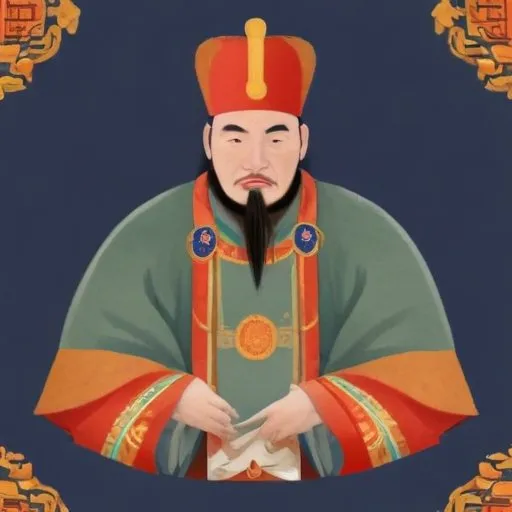
The last emperor of the Ming dynasty, ruling from 1627 to 1644, known for his attempts to reform the government and military, but ultimately failing to prevent the fall of the dynasty.
The Chongzhen Emperor, born Zhu Youjian, was the 17th and final emperor of the Ming dynasty, reigning from 1627 to 1644. He is remembered for his struggles to maintain power amidst peasant rebellions and the looming threat of the Manchu invasion, ultimately leading to the downfall of the Ming dynasty.
Zhu Youjian was born on February 6, 1611, as the fifth son of the Taichang Emperor and one of his low-ranking concubines, Lady Liu. After his mother's mysterious execution when he was just four years old, he was adopted by his father's other concubines, Consort Kang and Consort Zhuang.
The Chongzhen Emperor ascended to the throne in 1627, following the death of his brother, the Tianqi Emperor. During his reign, he faced numerous challenges, including peasant rebellions led by Li Zicheng and the growing threat of the Manchu invasion from the north. Despite his efforts to defend the northern frontier, the Manchu ultimately breached the Great Wall, and the Chongzhen Emperor was forced to commit suicide on April 25, 1644, marking the end of the Ming dynasty.
In historical texts, the Chongzhen Emperor is commonly referred to as Sizong, a temple name bestowed upon him by Zhu Yousong, the Hongguang Emperor of the Southern Ming dynasty. However, the Southern Ming rulers later changed his temple name to Yizong and then to Weizong. The Qing dynasty, which succeeded the Ming, initially gave him the temple name Huaizong, but later revoked it.
The Chongzhen Emperor's legacy is a testament to his bravery and dedication to his people, despite the tumultuous circumstances of his reign. His name has become synonymous with the fall of the Ming dynasty and the rise of the Qing dynasty.
The Chongzhen Emperor's reign was marked by turmoil and uncertainty, as the Ming dynasty struggled to maintain power in the face of internal strife and external threats. His ultimate sacrifice has been remembered as a symbol of the fall of the Ming dynasty and the beginning of a new era in Chinese history.
Today, the Chongzhen Emperor's legacy serves as a reminder of the importance of strong leadership and the enduring spirit of the Chinese people. His story continues to captivate historians and scholars, offering a glimpse into the complexities of China's rich cultural heritage.
Born in 1130
A leading figure in Confucianism, he synthesized Confucian classics into a coherent philosophical system, influencing East Asian thought for centuries. His teachings emphasized moral cultivation and self-reflection.
Born in 1605
The last emperor of the Ming dynasty, known for his incompetence and indulgence, leading to the downfall of the dynasty and the rise of the Qing dynasty.
Born in 1470
A renowned painter, calligrapher, and poet, celebrated for his elegant and expressive brushstrokes, capturing the essence of Chinese landscapes and literati culture.
Born in 1587
Chinese geographer and explorer who traveled extensively throughout China, documenting its geography, natural resources, and cultural practices, leaving behind a treasure trove of information on the country's history and development.
