


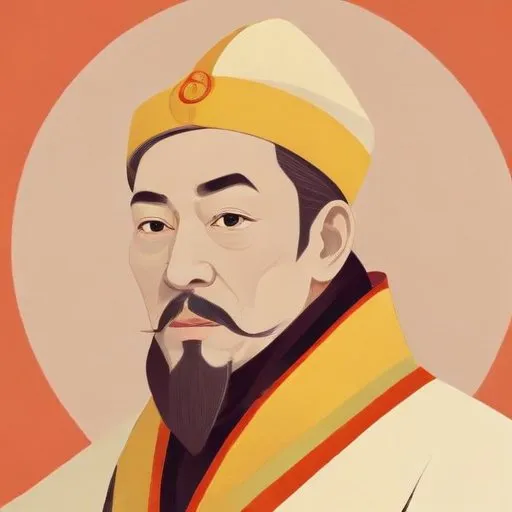
The last emperor of the Ming dynasty, who led a peasant uprising that overthrew the dynasty and established the short-lived Shun dynasty. He's known for his brief but significant reign and his role in ending the Ming dynasty.
Li Zicheng, also known as the "Dashing King", was a Chinese peasant rebel leader who orchestrated the downfall of the Ming dynasty in 1644 and ruled over northern China briefly as the Yongchang Emperor. His legendary rise to power and brief reign marked a tumultuous period in Chinese history.
Born in 1606 to an impoverished family of farmers in Li Jiqian village, Yanan prefecture, northeast Shaanxi province, Li Zicheng's early life was marked by hardship and struggle. His brother, 20 years his senior, raised Li Zicheng alongside his son and Zicheng's nephew, Li Guo. Despite the challenges, Li Zicheng managed to acquire literacy, although the source of his education remains disputed.
In 1630, Li Zicheng's life took a dramatic turn when he was put on public display in an iron collar and shackles for failing to repay loans to a usurious magistrate. However, in a surprising twist, a group of sympathetic peasants freed Li from his shackles, spirited him to a nearby hill, and proclaimed him their leader. This marked the beginning of Li Zicheng's journey as a rebel leader, as he and his band managed to ambush a group of government soldiers and obtain their first real weapons.
The late Ming dynasty era was characterized by financial woes, environmental problems, and widespread disease, creating a perfect storm of circumstances that contributed to Li Zicheng's rise to power. The Chongzhen Great Plague, which hit the Yangzi region in 1639, further exacerbated social discontent caused by famine, drought, and government failure to protect its people.
In 1644, Li Zicheng led a peasant rebellion that eventually overthrew the Ming dynasty, establishing the short-lived Shun dynasty with himself as the Yongchang Emperor. Although his reign was brief, lasting only a year, Li Zicheng's legacy as a rebel leader who challenged the status quo has endured in Chinese history.
Li Zicheng's rebellion marked a significant turning point in Chinese history, paving the way for the eventual rise of the Qing dynasty. His legacy serves as a testament to the power of peasant rebellions in challenging the authority of imperial dynasties. Despite his brief reign, Li Zicheng's impact on Chinese history has been profound, cementing his place as one of the most important figures of the 17th century.
Li Zicheng's story is a testament to the power of determination and leadership, serving as an inspiration to those who dare to challenge the status quo.
Born in 1893
Leader of the Chinese Communist Party who implemented radical social and economic reforms, including the Great Leap Forward and the Cultural Revolution, shaping modern China's politics and economy.
Born in 1886
A prominent Chinese military leader and politician who played a crucial role in the Chinese Civil War and the establishment of the People's Republic of China, serving as the second-in-command to Mao Zedong. He's most known for his military strategies and leadership during the war.
Born in 1898
The first Premier of the People's Republic of China, serving from 1949 until his death in 1976, is most known for his key role in the Chinese Communist Party and his diplomatic efforts to improve relations with the West. He played a crucial part in shaping China's foreign policy and economy during a pivotal period in the country's history.
Born in 1898
A prominent military leader who played a crucial role in the Chinese Civil War and later became a key figure in the Communist Party, known for his criticisms of Mao's policies. He was eventually purged and persecuted during the Cultural Revolution.
Born in 1907
A powerful Chinese military leader and politician who rose to prominence during the Chinese Civil War and later became a close ally of Mao Zedong, playing a crucial role in the Cultural Revolution. He is infamous for his alleged plot to overthrow Mao and his mysterious death in a plane crash.
Born in 1904
A Chinese revolutionary and statesman who led the country's economic reforms, transforming it into a global superpower. He's credited with opening up China to the world and introducing capitalist principles.
Born in 1887
Led the Nationalist Party in China, fighting against the Communist Party and later establishing the government of Taiwan. He's known for his role in shaping modern Chinese history.
