


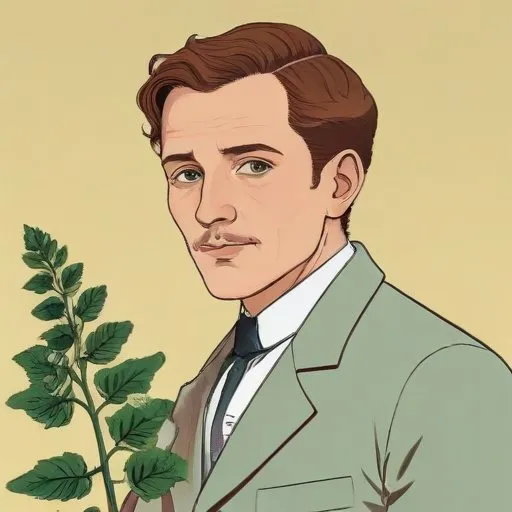
German botanist who contributed significantly to the field of phycology, studying and describing numerous species of algae. His work remains essential for understanding marine ecosystems.
Christian August Friedrich Garcke, a German botanist, left an indelible mark on the world of botany with his groundbreaking work, Flora von Nord und Mitteldeutschland (Flora of North and Central Germany). Published in 1849, this iconic book showcased his dedication to the field, providing a comprehensive guide to the plant species of the region. His work was so influential that it went on to have multiple editions, solidifying his position as a leading authority in botany.
Garcke was born on October 25, 1819, in Brunrode, Saxony-Anhalt. He pursued theology studies in Halle, eventually obtaining his doctorate from the University of Jena in 1844. However, his true passion lay in botany, which he continued to study as a private scholar in Halle.
In 1851, Garcke relocated to Berlin, where he had the opportunity to work alongside the renowned botanist Alexander Braun. This collaboration not only broadened his knowledge but also paved the way for his future success. During this period, he began to focus on pharmacognosy, a branch of pharmacology that deals with the study of medicinal substances derived from plants.
In 1865, Garcke was appointed curator at the Königlichen Herbarium (later known as the Königlich botanisches Museum) in Berlin. His expertise in pharmacognosy earned him an associate professorship in 1871, further cementing his reputation as a leading botanist.
From 1867 to 1882, Garcke served as the editor of the esteemed journal Linnaea. In addition to his work on Flora von Nord und Mitteldeutschland, he authored another significant publication, Flora von Halle, which was published in two volumes (1848 and 1856). These volumes showcased his meticulous research and extensive knowledge of the plant species in the Halle region.
Christian August Friedrich Garcke's contributions to botany are still celebrated today. A number of plant species, such as Thespesia garckeana, bear his name as a testament to his groundbreaking work. His legacy extends beyond the scientific community, inspiring future generations of botanists and naturalists.
Garcke passed away on January 10, 1904, leaving behind a rich legacy in the world of botany. His work continues to inspire and educate, serving as a testament to his dedication and passion for the field.
Christian August Friedrich Garcke's remarkable journey, marked by his tireless pursuit of botanical knowledge, has left an indelible mark on the scientific community. His works continue to inspire and educate, serving as a testament to his boundless passion for the wonders of the natural world.
Born in 1707
Developed the system of binomial nomenclature, which is still used today to classify and name living organisms. This system has had a profound impact on the fields of biology, ecology, and conservation.
Born in 1744
A French soldier, biologist, and academic who developed a theory of inheritance of acquired characteristics, proposing that organisms adapt to their environment and pass on those traits to their offspring.
Born in 1769
A pioneering geographer and explorer who mapped much of South America and discovered the Caspian Sea's connection to the Black Sea, greatly advancing our understanding of the natural world.
Born in 1749
A German literary giant who penned iconic works like "Faust" and "The Sorrows of Young Werther", shaping the Romantic movement and influencing countless writers.
Born in 1659
Developed the phlogiston theory, a precursor to modern chemistry, and made significant contributions to the field of medicine.
Born in 1794
A German botanist and explorer who traveled extensively in South America, discovering and documenting thousands of plant species, and creating the first comprehensive flora of Brazil.
Born in 1828
Pioneering microbiologist who discovered the first bacterium, Bacillus subtilis, and laid the foundation for modern bacteriology. His work revolutionized the field of microbiology and paved the way for significant advances in medicine and agriculture.
