


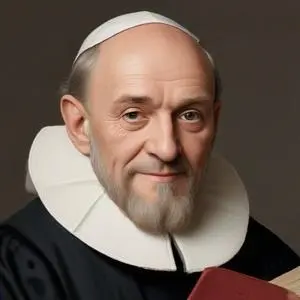
A 17th-century pioneer who merged law and philosophy, advocating for Enlightenment values and tolerance, while criticizing witch hunts and superstition.
Christian Thomasius, a renowned German jurist and philosopher, is best known for his groundbreaking work in pushing the boundaries of traditional thought and sparking the Enlightenment in Germany. As a pioneer in the field of natural law, he boldly challenged conventional wisdom, advocating for reason and individual freedom.
Born on January 1, 1655, in Leipzig, Germany, Thomasius was educated by his father, Jakob Thomasius, a junior lecturer at Leipzig University. This early exposure to intellectual pursuits ignited a passion for learning in young Christian, who went on to study law at the University of Frankfurt Oder, earning his doctorate in 1679.
In 1680, Thomasius married Anna Christine Heyland and began practicing law in Leipzig, soon followed by an appointment as a lecturer at the university's law school. His exceptional abilities and provocative ideas quickly gained attention,especially his attack on traditional prejudices in theology and jurisprudence.
In 1685, Thomasius published a dissertation, De crimine bigamiae (The Crime of Bigamy), which argued that bigamy was permissible under natural law. This bold assertion marked the beginning of his campaign to promote individual freedom and challenge arbitrary authority.
In 1687, Thomasius made history by lecturing in German instead of Latin, a daring innovation that paved the way for the Enlightenment in Germany. His emphasis on natural reason and individual freedom resonated with the Pietists, a group of radical Protestants who sought to reform the Lutheran Church.
Thomasius' publication of a monthly periodical, Scherzhafte und ernsthafte, vernüftige Gedanken über allerhand lustige und nützliche Bücher und Fragen, attracted controversy due to its ridicule of pedantic scholars and defense of mixed marriages between Lutherans and Calvinists. His views on natural law, emphasizing reason over tradition, further fueled the debate.
Christian Thomasius' courageous challenge to traditional thought laid the groundwork for the Enlightenment in Germany. His emphasis on individual freedom, natural reason, and the importance of language in shaping thought paved the way for future thinkers such as Immanuel Kant. As a pioneer in natural law, Thomasius' work continues to influence legal philosophy to this day.
Thomasius' advocacy for reason and individual freedom has had a lasting impact on modern society. His ideas have shaped the way we think about human rights, personal autonomy, and the role of language in shaping our understanding of the world.
Christian Thomasius' unwavering commitment to the principles of reason, individual freedom, and natural law has left an indelible mark on the history of philosophy, shaping the course of modern thought and inspiring future generations of thinkers.
Born in 1724
Developed influential philosophical frameworks, such as the Critique of Pure Reason, that shaped modern Western thought on ethics, morality, and human understanding.
Born in 1712
A pioneering thinker who shaped modern democracy and education with his ideas on social contracts, general will, and the importance of early childhood education. His writings influenced the French Revolution and modern political thought.
Born in 1762
A 17th-century naval commander who fought against the Spanish Armada and later became a privateer, known for his bravery and cunning at sea.
Born in 1588
A 17th-century philosopher who introduced the concept of social contract, arguing that people voluntarily give up some rights to a sovereign power in exchange for protection and stability. His ideas shaped modern political thought and the nature of government.
Born in 1632
A 17th-century philosopher and scholar who developed a comprehensive philosophical system that emphasizes God, nature, and human freedom, influencing modern thought on ethics, politics, and religion.
Born in 1596
Developed influential philosophical and mathematical concepts, including the famous phrase "I think, therefore I am," and laid the foundation for modern Western philosophy.
Born in 1646
Developed calculus independently of Isaac Newton, and made major contributions to the fields of philosophy, politics, and history.
Born in 1583
A 17th-century philosopher and jurist who laid the foundations for modern international law, particularly the concept of "just war" and the laws of the sea.
