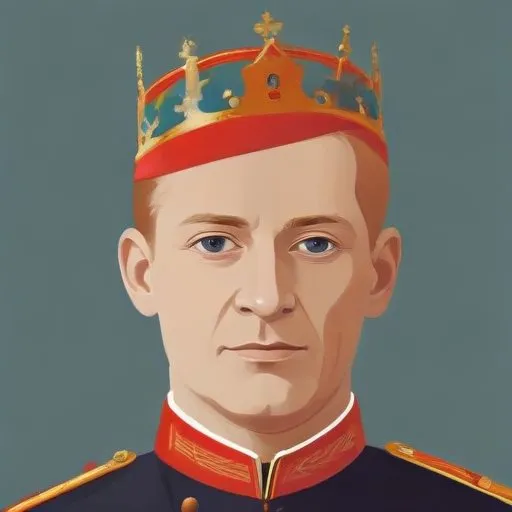
Christian VI of Denmark: A Visionary King and Authoritarian Ruler
Introduction
Christian VI of Denmark, who reigned from 1730 to 1746, is remembered as a shrewd politician and one of the most enigmatic monarchs of the Oldenburg dynasty. He is best known for his authoritarian regime, which introduced compulsory confirmation and a nationwide school system, making him a pioneer in education and social reform.
Early Life and Education
Christian VI was born on November 30, 1699, at Copenhagen Castle, as the second but eldest surviving son of King
Frederick IV of Denmark and
Louise of Mecklenburg-Güstrow. As the crown prince, he received a superior education than his father and grandfather, which enabled him to develop a keen sense of politics and governance. From 1706, he was allowed to learn Danish, but he preferred to speak and write in German, which became an integral part of his daily life.
Reign and Major Reforms
Christian VI's reign was marked by several significant reforms, which had a profound impact on Danish society. In 1736, he introduced compulsory confirmation, which made religious education mandatory for all citizens. This move was seen as a significant step towards creating a more harmonious and cohesive society. Three years later, in 1739, he established a nationwide school system, which aimed to provide education to all segments of society, regardless of social class or background.
Ambitions and Motto
Christian VI's motto, "Deo et populo" (For God and the People), reflected his deep-seated commitment to his country and its people. His ambition was to create a more just and equitable society, where education and social reform would be the cornerstones of progress.
Personal Life and Marriage
Christian VI married
Sophie Magdalene of Brandenburg-Kulmbach, a lady-in-waiting at the court of the Saxon-Polish queen Christiane Eberhardine. Despite her humble background, Sophie brought a sense of refinement and culture to the Danish court, which had a lasting impact on the royal family.
Legacy and Impact
Christian VI's reign was marked by several significant achievements, which continue to shape Danish society to this day. His introduction of compulsory confirmation and a nationwide school system made him a pioneer in education and social reform. His authoritarian regime, though often criticized, brought stability and growth to Denmark, making him one of the most important monarchs of the Oldenburg dynasty.
Trivia and Fun Facts
- Christian VI was the first king of the Oldenburg dynasty to refrain from entering into any war.
- He was crowned king at the age of 31, succeeding his father, Frederick IV.
- During his reign, Copenhagen Castle underwent significant renovations, which transformed it into a grand palace.
Conclusion
Christian VI of Denmark was a visionary king who left an indelible mark on Danish history. His authoritarian regime, though often criticized, introduced several significant reforms that continue to shape Danish society. His commitment to education and social reform made him a pioneer in his time, and his legacy continues to inspire generations to come.
FAQ
Who was King Christian VI of Denmark?
King Christian VI of Denmark was the King of Denmark and Norway from 1730 to 1746, known for his absolutist rule and cultural pursuits, such as building the Christiansborg Palace in Copenhagen.
What was the significance of Christian VIs reign?
Christian VIs reign was marked by a period of cultural and economic growth in Denmark, including the establishment of the University of Copenhagen and the Royal Theater.
How did Christian VIs foreign policy impact Denmark?
Christian VIs foreign policy was focused on maintaining peace and neutrality, which allowed Denmark to avoid involvement in costly wars and focus on internal development.
What was Christian VIs role in the development of Copenhagen?
Christian VI played a key role in the development of Copenhagen, commissioning the construction of several notable buildings, including the Frederiksberg Palace and the Church of Our Lady.
What is Christian VIs legacy in Denmark?
Christian VIs legacy in Denmark is one of cultural and economic progress, and he is remembered as a strong and effective ruler who laid the foundations for Denmarks future prosperity.