


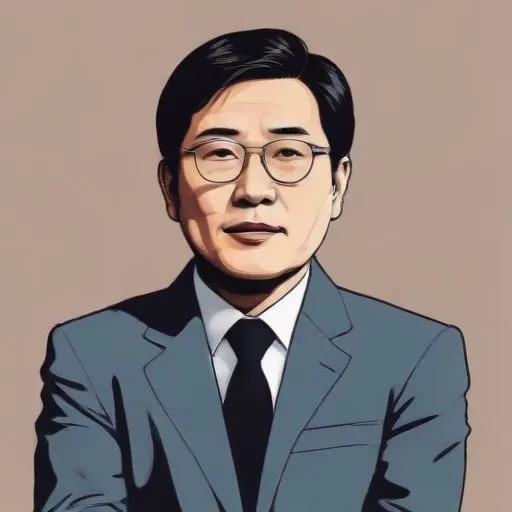
South Korea's Minister of Unification, a journalist-turned-politician who played a key role in shaping the country's reunification policies and inter-Korean relations. He's known for his efforts to promote peace and cooperation between North and South Korea.
Chung Dongyoung is a South Korean politician who made his mark in the country's political scene as the Minister of Unification from 2004 to 2005 and later as the presidential nominee of the United New Democratic Party in 2007. He is known for his strong support of the Sunshine Policy, a diplomatic initiative aimed at improving relationships between North and South Korea.
Chung was born on July 27, 1953, in Sunchang County, North Jeolla, South Korea. He graduated from Seoul National University in 1979 with a bachelor's degree in Korean History and later obtained a master's degree from the University of Wales.
Before entering politics, Chung worked as a journalist and anchor at the Munhwa Broadcasting Corporation (MBC). He served as an anchor at MBC Newsdesk from the late 1980s to the early 1990s, where he developed his skills in reporting and analysis.
Chung's political career began when he was elected to the National Assembly in 1996, representing the National Congress for New Politics. He later joined the Millennium Democratic Party and was re-elected to the National Assembly in 2000. In 2004, he was appointed as the Minister of Unification, a position he held until 2005.
One of Chung's most notable achievements is the foundation of the Kaesong Industrial Complex, an exclusive industrial zone set up in the southernmost province of North Korea, Kaesong. The complex was established to promote economic cooperation between North and South Korea and has been credited with promoting peace on the Korean peninsula.
In 2007, Chung was nominated as the presidential candidate of the United New Democratic Party. Although he did not win the election, his nomination highlighted his reputation as a strong leader and a unifying figure in South Korean politics.
Chung has faced criticism for not taking a tougher stance on North Korea, and for his rhetorical clashes with the United States, which some argue weakened relations between the two countries. He has also been accused of attempting to distract reporters from a meeting of activists for human rights in North Korea.
Despite the controversies, Chung's contributions to South Korean politics and his efforts to promote peace on the Korean peninsula are undeniable. His legacy continues to inspire new generations of politicians and policymakers in South Korea and beyond.
79 Years Old
A South Korean soldier-turned-politician who served as the country's 9th President, known for his progressive reforms and efforts to reduce corruption. He's also remembered for his tragic death by suicide in 2009.
84 Years Old
South Korea's first businessman president, known for his economic reforms and infrastructure projects, particularly the Four Major Rivers Project. He was also involved in a corruption scandal that led to his imprisonment.
74 Years Old
The first female president of South Korea, serving from 2013 to 2017, known for her efforts to improve relations with North Korea and her subsequent impeachment and imprisonment for corruption.
73 Years Old
The 19th President of South Korea, a key figure in the country's efforts to reconcile with North Korea, known for his progressive policies and Nobel Peace Prize nomination.
Born in 1924
A South Korean politician and Nobel laureate who served as the country's 8th president, known for his Sunshine Policy towards North Korea and efforts to promote democracy and human rights. He is a symbol of South Korea's transition from dictatorship to democracy.
Born in 1926
A South Korean politician who served as Prime Minister and played a key role in the country's economic development and democratization. He's also known for his involvement in the Gwangju Democratization Movement.
95 Years Old
A South Korean general and politician who served as the 5th President of South Korea, known for his military coup and subsequent authoritarian rule. He's infamous for his role in the Gwangju Democratization Movement's brutal suppression.
