


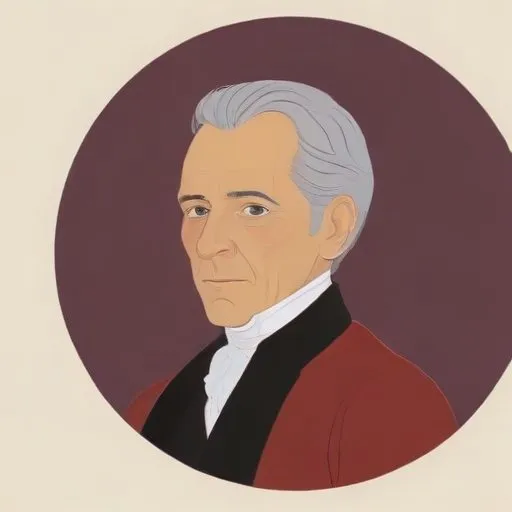
A 17th-century French educator and courtier who standardized the French language, establishing rules and norms that shaped modern French grammar and vocabulary.
Claude Favre de Vaugelas, a 17th-century Savoyard grammarian and man of letters, is renowned for his significant contributions to the French language. He is credited with purifying French diction, making him a household name in the world of linguistics.
Born on January 6, 1585, in Meximieux, Duchy of Savoy, Vaugelas was the son of Antoine Favre, a distinguished president, and his mother, who bore the same name as her husband. He inherited the Vaugelass estate from his mother, which would later become an integral part of his identity.
Vaugelas served as a gentleman-in-waiting to Gaston, Duke of Orléans, and remained loyal to the prince even in his disgrace. This loyalty, however, cost him a pension from the crown, which he was largely dependent on. Despite this, his thorough knowledge of the French language and his correct speech earned him a place among the original members of the Académie française in 1634.
Vaugelas' most notable work, Remarques sur la langue française, published in 1647, is a landmark in the history of the French language. In this book, he advocated for the idea that words and expressions should be judged by the current usage of the best society. As a regular of the Hôtel de Rambouillet, Vaugelas was well-positioned to observe and document the linguistic habits of the elite.
Vaugelas' work did not go unchallenged. Scipion Dupleix, in his Liberté de la langue française dans sa pureté (1651), pleaded for a richer and freer language, reminiscent of the 16th century. Franois de La Mothe-Le Vayer also expressed similar sentiments in his Lettres, criticizing Vaugelas' restrictive approach to language.
Towards the end of his life, Vaugelas became a tutor to the sons of Thomas Francis of Savoy, Prince of Carignano. He passed away in Paris on February 26, 1650. His translation from Quintus Curtius, La Vie d'Alexandre, was published posthumously in 1653, showcasing his mastery of language and style.
Today, Vaugelas is remembered as a pioneer in French linguistics, whose work continues to influence the language and its usage. His legacy is a testament to the power of language in shaping culture and society.
Vaugelas' emphasis on purity of language and his efforts to standardize French diction have had a lasting impact on modern French. His work continues to inspire linguists, writers, and language enthusiasts, cementing his place as one of the most important figures in the history of the French language.
Born in 1585
A powerful and cunning statesman who dominated French politics during the 17th century, known for his ruthless suppression of dissent and centralization of power. He was a master strategist and diplomat who shaped the course of European history.
Born in 1533
A 16th-century French philosopher and writer who pioneered the essay as a literary form, exploring human nature, morality, and the human experience through personal anecdotes and philosophical musings.
Born in 1606
A 17th-century French mastermind behind iconic plays like "Le Cid" and "Horace", known for pioneering the classical French tragedy genre.
Born in 1622
A 17th-century master of comedy, he penned witty plays that satirized the French aristocracy, leaving a lasting impact on Western theater. His works remain widely performed and adapted today.
Born in 1639
A 17th-century master of French tragedy, crafting intricate, psychologically complex dramas that probed the human condition, influencing the development of Western theatre.
Born in 1636
A 17th-century French poet and critic who advocated for reason and morality in literature, and is known for his influential writings on poetry and aesthetics.
Born in 1623
A 17th-century genius who made major contributions to mathematics, physics, and philosophy, inventing the mechanical calculator and developing the theory of probability. His writings also explored the human condition and faith.
