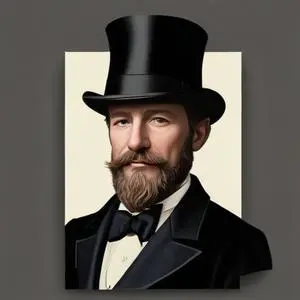
Collis Potter Huntington: The Visionary Railroad Magnate
A Legacy of Innovation and Progress
Collis Potter Huntington was a pioneering American industrialist and railway magnate, renowned for his instrumental role in shaping the United States' transcontinental railroad network. Along with Leland Stanford, Mark Hopkins, and
Charles Crocker, he formed the quartet of investors known as the "Big Four," who brought
Theodore Judah's vision of a transcontinental railroad to life.
Early Life and Career
Born on October 22, 1821, in Harwinton, Connecticut, Huntington began his career as a shopkeeper before moving to Virginia, where he established himself as a successful businessman and entrepreneur. His early ventures included mercantile and banking interests, which laid the foundation for his future success in the railroad industry.
The Big Four and the Central Pacific Railroad
In 1861, Huntington joined forces with Stanford, Hopkins, and Crocker to form the Central Pacific Railroad Company of California, which aimed to build the western portion of the first U.S. transcontinental railroad. As one of the principal investors and leaders, Huntington played a crucial role in securing funding, negotiating with government officials, and overseeing construction. The Central Pacific Railroad, completed in 1869, revolutionized transportation and commerce across the United States.
Expansion and Diversification
Huntington's railroad empire continued to expand and diversify, with significant investments in the Southern Pacific Railroad and the Chesapeake and Ohio Railway (CO). The CO, completed in 1873, fulfilled a long-held dream of Virginians, linking the James River at Richmond to the Ohio River Valley. This development led to the growth of the small town of Guyandotte, West Virginia, which was renamed Huntington in his honor.
Newport News Shipbuilding and Drydock Company
Huntington's vision extended beyond railroads to shipbuilding and drydocking. He established the Newport News Shipbuilding and Drydock Company, which became a vital component of the U.S. naval industry. His efforts contributed to the incorporation of Newport News, Virginia, as a new independent city.
Personal Milestones and Key Life Events
Throughout his life, Huntington was driven by a strong work ethic and a passion for innovation. He married Elizabeth Stillman Stoddard in 1844, and the couple had no children together. However, Huntington's stepson, Archer M. Huntington, and nephew, Henry E. Huntington, continued his legacy in the railroad and shipping industries.
Impact on Modern Society
Collis Potter Huntington's contributions to the development of the U.S. railroad network, coal industry, and shipbuilding sector have had a lasting impact on modern society. His vision and leadership paved the way for the growth of industries, cities, and commerce across the United States.
Legacy and Honors
Huntington's legacy is commemorated in various ways, including the naming of the city of Huntington, West Virginia, and the establishment of the Collis P. Huntington Memorial Library in Newport News, Virginia. His contributions to the development of the U.S. railroad industry are recognized through the preservation of historic railroad facilities and equipment.
A Life of Adventure and Enterprise
Collis Potter Huntington's remarkable life is a testament to the power of innovation, perseverance, and vision. As a pioneering entrepreneur and industrialist, he left an indelible mark on American history, shaping the course of the country's economic and industrial development.