


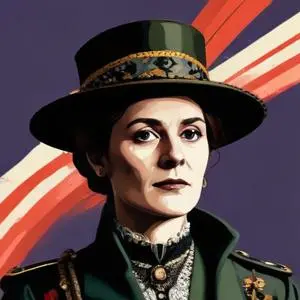
Irish revolutionary and politician who broke gender barriers as the first woman elected to the UK House of Commons, advocating for Irish independence and women's rights.
Constance Markievicz, a trailblazing Irish politician, revolutionary, and suffragist, made history as the first woman elected to the Westminster Parliament and the first female cabinet minister in Europe. Her unwavering commitment to Irish independence and social justice led her to play a pivotal role in shaping Ireland's future.
Born Constance Georgine Gore-Booth on February 4, 1868, in London, she was the daughter of Sir Henry Gore-Booth, an Anglo-Irish landlord, and Georgina, Lady Gore-Booth. Her family's commitment to social justice and her father's humanitarian efforts during the 1879-80 famine in County Sligo instilled in her a sense of compassion and responsibility.
Markievicz's involvement in the Irish nationalist movement began with her participation in the 1916 Easter Rising, where she fought alongside James Connolly and other republicans. Her role in the uprising led to her sentence of death, later commuted to life imprisonment due to her gender. This experience only strengthened her resolve, and she continued to fight for Irish independence and women's rights.
Markievicz's unwavering commitment to Irish independence and socialism led to criticisms from those who opposed her radical views. Her support for the anti-Treaty side in the Irish Civil War and her later involvement with Fianna Fáil sparked controversy among her contemporaries.
Markievicz married Casimir Markievicz, a Polish count, in 1900. The couple had one son, Maeve, who died in 1919. Her personal relationships were often overshadowed by her dedication to the Irish cause, but her marriage and motherhood played a significant role in shaping her perspective on women's rights and social justice.
"The only way to get anything done is to do it yourself."
Constance Markievicz's groundbreaking achievements paved the way forfuture generations of women in politics. Her unwavering commitment to Irish independence, socialism, and women's rights continues to inspire and influence modern-day politicians and activists.
As we reflect on the life and legacy of this trailblazing rebel countess, we are reminded that true leadership is about courage, conviction, and an unrelenting pursuit of justice – qualities that Constance Markievicz embodied throughout her remarkable life.
Born in 1882
Leader of Ireland's struggle for independence from Britain, serving as both Prime Minister and President, and key figure in shaping the country's modern identity.
Born in 1866
Irish nationalist and political activist who fought for Irish independence and women's rights, inspiring generations of activists and writers.
Born in 1879
Irish revolutionary leader who sparked the Easter Rising, a pivotal event in Ireland's struggle for independence. He's remembered for his bravery and poetic writings.
Born in 1868
A Scottish-born Irish rebel leader who played a key role in the Easter Rising of 1916, advocating for Irish independence from British rule through socialist and republican ideologies.
Born in 1890
Leader of the Irish independence movement, instrumental in negotiating the Anglo-Irish Treaty, and a key figure in the Irish War of Independence.
Born in 1871
Leader of the Irish independence movement and key negotiator of the Anglo-Irish Treaty, shaping Ireland's path to independence.
Born in 1902
Irish revolutionary who fought in the Anglo-Irish War and was executed by the British at 18, becoming a martyr for the Irish independence movement.
