


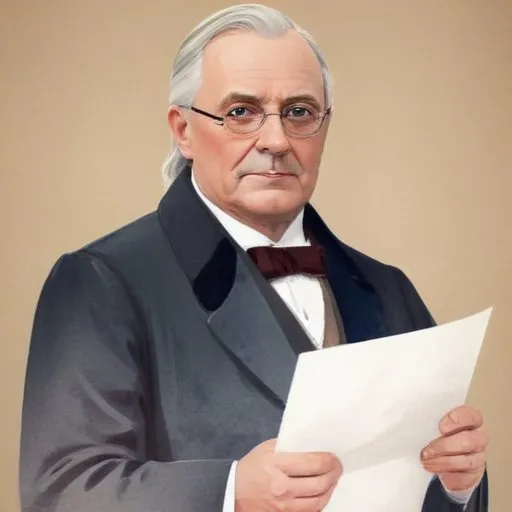
A German lawyer and politician who served as the 4th Chancellor of Weimar Germany, known for his efforts to stabilize the country's economy and politics during a tumultuous post-WWI period.
Constantin Fehrenbach, a German politician of great renown, is famously known for his leadership of the Catholic Centre Party and his tenure as the President of the Reichstag in 1918, as well as the President of the Weimar National Assembly from 1919 to 1920. He later went on to become the Chancellor of Germany in June 1920, a position he held until May 1921.
Fehrenbach was born on January 11, 1852, in Wellendingen, near Bonndorf, in the Grand Duchy of Baden, to Johann Georg Fehrenbach, a teacher, and his wife Rosina. He attended the Freiburg Boys Seminary and the Berthold Gymnasium, graduating in 1871. He began studying Catholic theology at the University of Freiburg before switching to law in 1875. During his studies, he joined a student fraternity that gave him access to circles of notables among the local bourgeoisie.
Fehrenbach started his political career in 1884 when he became a member of the Freiburg city council for the Catholic Centre Party. The next year, he was elected to the Landtag state legislature of Baden, again for the Centre Party. This marked the beginning of his illustrious political journey, which saw him take on various leadership roles and contribute significantly to German politics.
Fehrenbach's time as Chancellor of Germany was marked by his efforts to navigate the complexities of the Treaty of Versailles. He faced significant challenges in complying with the treaty's terms, particularly regarding war reparations payments to the Allies. The inability to reach a consensus on this issue led to his resignation in May 1921.
Fehrenbach's contributions to German politics and his leadership of the Catholic Centre Party have left a lasting impact on the country's political landscape. His commitment to peaceful negotiations and cooperation, particularly during the tumultuous post-World War I era, earned him recognition as a pillar of German politics.
Fehrenbach married Maria, née Hossner, in 1879, and they had one daughter together. He was known for his strong connections with Catholic workers' associations and Catholic trade unions, which formed an integral part of his political ideology.
Constantin Fehrenbach's remarkable life and career serve as a testament to his dedication to German politics and his commitment to peaceful cooperation. His leadership and vision continue to inspire generations, and his legacy remains an integral part of German history.
Born in 1870
The 11th Chancellor of Germany, a journalist-turned-politician, led the country during the tumultuous Weimar Republic era, implementing key economic reforms. He's remembered for stabilizing the German economy after World War I.
Born in 1863
A German lawyer and politician who served as the 17th Chancellor of Germany during the Weimar Republic, known for his efforts to stabilize the economy and government during a tumultuous period. He played a crucial role in shaping Germany's post-WWI politics and economy.
Born in 1879
Chancellor of Germany during the Weimar Republic, known for his efforts to stabilize the economy and promote international cooperation after World War I.
Born in 1860
A German lawyer and politician who served as Vice-Chancellor of Germany during the Weimar Republic, known for his role in shaping the country's post-WWI government and economy.
Born in 1885
Chancellor of Germany during the Weimar Republic, implemented austerity measures to address the Great Depression, but ultimately failed to prevent Hitler's rise to power.
