


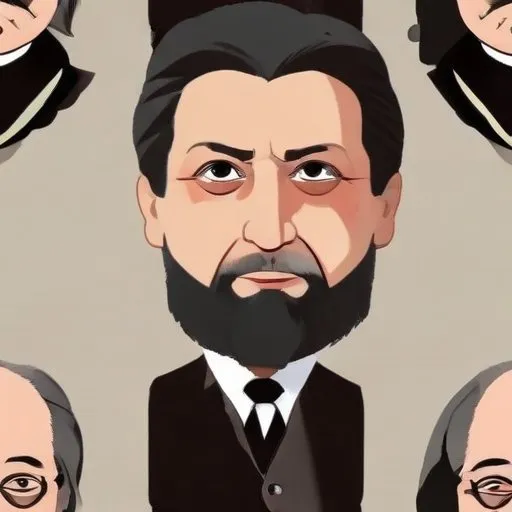
A German lawyer and politician who served as the 17th Chancellor of Germany during the Weimar Republic, known for his efforts to stabilize the economy and government during a tumultuous period. He played a crucial role in shaping Germany's post-WWI politics and economy.
Wilhelm Marx, a stalwart figure in German politics, is renowned for his unwavering dedication to the nation, serving as the Chancellor of Germany twice during the tumultuous Weimar Republic era. With a cumulative tenure of 3 years and 73 days, Marx holds the distinction of being the longest-serving Chancellor of his time.
Born on January 15, 1863, in Cologne, Germany, Marx was the son of a Catholic school rector, Johann Marx, and his wife, Gertrude. His early life was marked by a strong sense of social responsibility, which would later shape his political career.
After completing his secondary education at the Marzellengymnasium in 1881, Marx pursued a degree in jurisprudence at the University of Bonn. During his student years, he became an active member of the Catholic Student Association Arminia of Bonn, fostering a deep connection with his faith and community.
Marx's professional journey began in 1888, when he passed the second state exam for the Prussian civil service. He subsequently worked as a judge, gradually rising through the ranks to become a prominent figure in the Catholic Centre Party.
In 1919, Marx was elected to the Weimar National Assembly, where he played a pivotal role in drafting Germany's new constitution. He later served in the Reichstag from 1920 to 1932, dedicated to steering the country through its post-war crisis.
Marx's first stint as Chancellor of Germany, from 1923 to 1925, was marked by his resolute efforts to address the hyperinflation and rebellious state governments that threatened the nation's stability. His government worked tirelessly to restore economic order and bring Germany back from the brink of collapse.
In his second term, from 1926 to 1928, Marx continued to drive progress, successfully securing Germany's entry into the League of Nations in 1927. His administration also introduced several progressive reforms, including family allowances for state employees and comprehensive unemployment insurance.
Marx's personal life was defined by his strong family bonds and commitment to his community. He married Johanna Verkoyen in 1891, and the couple had three sons and a daughter. One of their sons tragically lost his life in World War I.
After resigning from the Reichstag in 1932, Marx remained engaged with various civic organizations, working towards the betterment of German society. Despite living through the tumultuous Nazi era, Marx remained steadfast in his commitment to his nation, passing away on August 5, 1946, in Bonn.
Wilhelm Marx's remarkable life serves as a testament to his unwavering dedication to public service, his resolve in the face of adversity, and his commitment to fostering a more just and equitable society. As one of the longest-serving Chancellors of the Weimar Republic, Marx's legacy continues to inspire future generations of leaders and policymakers.
| Key Dates: | |
|---|---|
| 1863 | Born in Cologne, Germany |
| 1881 | Completed secondary education at Marzellengymnasium |
| 1888 | Passed second state exam for Prussian civil service |
| 1919 | Elected to Weimar National Assembly |
| 1920 | Served in Reichstag |
| 1923-1925 | Served as Chancellor of Germany (first term) |
| 1926-1928 | Served as Chancellor of Germany (second term) |
| 1932 | Resigned from Reichstag |
| 1946 | Passed away in Bonn |
Through his remarkable life and career, Wilhelm Marx has left an indelible mark on German history, serving as a beacon of hope and stability during times of turmoil.
Born in 1815
Unified Germany's founder, a master strategist who forged a nation through diplomacy and war, leaving a lasting legacy in European politics.
Born in 1882
A German general and politician who briefly served as Chancellor of Germany in 1933, known for his failed attempts to stabilize the Weimar Republic and his role in Hitler's rise to power.
Born in 1879
A German nobleman who served as Chancellor of Germany in 1932, known for his role in appointing Adolf Hitler as Chancellor, paving the way for the Nazi regime.
Born in 1847
A German field marshal and politician who served as the 2nd President of Germany during the Weimar Republic, playing a crucial role in the rise of the Nazi Party. He's infamous for appointing Adolf Hitler as Chancellor of Germany in 1933.
Born in 1878
A German journalist and politician who served as Chancellor of Germany during the Weimar Republic, known for his efforts to rebuild Germany after World War I and his Nobel Peace Prize win in 1926. He played a crucial role in stabilizing the German economy and improving international relations.
Born in 1879
Chancellor of Germany during the Weimar Republic, known for his efforts to stabilize the economy and promote international cooperation after World War I.
Born in 1876
A German naval leader who played a key role in the Kriegsmarine during World War II, overseeing the German U-boat fleet and naval operations. He was a close advisor to Adolf Hitler and implemented the German naval strategy during the war.
Born in 1891
A German naval commander who led the U-boat fleet during World War II and briefly served as President of Germany after Hitler's death, known for his role in the war and its aftermath.
