


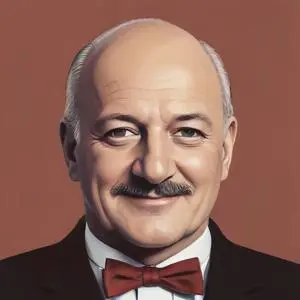
A German journalist and politician who served as Chancellor of Germany during the Weimar Republic, known for his efforts to rebuild Germany after World War I and his Nobel Peace Prize win in 1926. He played a crucial role in stabilizing the German economy and improving international relations.
Gustav Stresemann, a German statesman, is renowned for his pivotal role in reconciling Germany and France, earning him the prestigious Nobel Peace Prize in 1926, alongside French Prime Minister Aristide Briand. As the Chancellor of Germany from August to November 1923 and Foreign Minister from 1923 to 1929, Stresemann's diplomacy and vision for a united Europe paved the way for a new era of international cooperation.
Born on May 10, 1878, in Berlin, Germany, Stresemann was raised in a middle-class family. He attended the University of Berlin and Leipzig University, where he studied political economy, history, and international law. These formative years shaped his unique blend of liberalism and nationalism, which would define his political career.
After completing his doctorate, Stresemann worked in trade associations before entering politics. In 1907, he was elected to the Reichstag as a deputy for the National Liberal Party. Although he lost his seat in 1912, he was reelected two years later. During World War I, Stresemann was a vocal advocate for German militarism and expansionism, but his views underwent a significant transformation following Germany's defeat.
In 1917, Stresemann founded the German People's Party (DVP), which would become a significant force in German politics. Despite his initial monarchist beliefs, Stresemann came to accept the Weimar democracy and began working with the center and left-wing parties.
In August 1923, Stresemann was named Chancellor and Foreign Minister of a grand coalition government. During his brief chancellorship, he introduced the Rentenmark, successfully curbing hyperinflation in Germany. He also abandoned the policy of passive resistance against the French-Belgian occupation of the Ruhr, paving the way for improved relations with France.
Gustav Stresemann's commitment to fostering European cooperation and reconciliation has had a lasting impact on modern society. His vision for a united Europe, although ahead of its time, laid the foundation for the European integration movement of the post-World War II era.
Stresemann's unique blend of liberalism and nationalism shaped his political philosophy. He believed in the importance of individual freedoms, while also advocating for a strong national identity. This dichotomy defined his approach to politics and diplomacy.
Gustav Stresemann's life and legacy have inspired numerous literary and artistic works. His story has been featured in films, plays, and books, cementing his place in German cultural heritage.
Stresemann's life and career were marked by significant historical events, including World War I and the Weimar Republic. His legacy serves as a testament to the power of diplomacy and international cooperation in shaping the course of history.
Through his tireless efforts to promote peace and understanding, Gustav Stresemann has left an indelible mark on European history. His commitment to reconciliation and cooperation continues to inspire future generations of leaders and diplomats.
Born in 1897
A mastermind of Nazi propaganda, he crafted a persuasive narrative that fueled the Third Reich's rise to power, leaving a lasting impact on the world.
Born in 1889
The dictator of Nazi Germany, responsible for the genocide of six million Jews and millions of other people during World War II, and infamous for his extreme nationalist and anti-Semitic ideology.
Born in 1847
A German field marshal and politician who served as the 2nd President of Germany during the Weimar Republic, playing a crucial role in the rise of the Nazi Party. He's infamous for appointing Adolf Hitler as Chancellor of Germany in 1933.
Born in 1876
A German naval leader who played a key role in the Kriegsmarine during World War II, overseeing the German U-boat fleet and naval operations. He was a close advisor to Adolf Hitler and implemented the German naval strategy during the war.
Born in 1893
A German diplomat who served as the Nazi regime's Foreign Minister, orchestrating key alliances and treaties that led to World War II. He was a close associate of Adolf Hitler and played a crucial role in shaping Nazi foreign policy.
Born in 1900
Leading the SS and Gestapo, he oversaw the Nazi regime's brutal security apparatus and implemented the "Final Solution," orchestrating the genocide of six million Jews during World War II.
Born in 1893
A high-ranking Nazi official, he was a decorated World War I fighter pilot and later became a prominent politician, serving as Minister President of Prussia. He's infamous for his role in the Nazi regime and war crimes trials.
Born in 1894
A high-ranking Nazi official who flew to Scotland on a solo mission to negotiate peace with the UK, but was instead arrested and imprisoned.
