


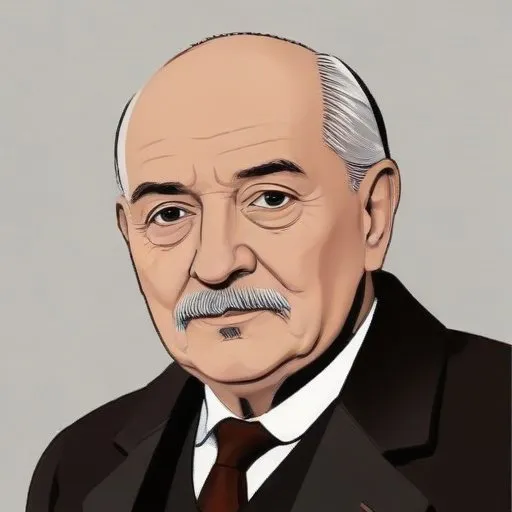
A Belgian physiologist and academic who discovered the role of the sinus and aortic nerves in regulating blood pressure, earning him the Nobel Prize in Physiology or Medicine in 1938. His work revolutionized the understanding of the nervous system's control over circulation.
Corneille Jean Franois Heymans, a Belgian physiologist, is renowned for his groundbreaking discovery of how blood pressure and oxygen content of the blood are measured by the body and transmitted to the brain. This pioneering work earned him the Nobel Prize in Physiology or Medicine in 1938.
Heymans was born on March 28, 1892, in Ghent, Belgium. He received his early education at the Jesuit College of Saint Barbara and later pursued a degree in medicine at Ghent University, graduating in 1920.
Heymans' thirst for knowledge took him to prestigious institutions across Europe and the United States. He worked under the guidance of renowned professors at the Collge de France, University of Lausanne, University of Vienna, University College London, and Case Western Reserve University School of Medicine.
In 1922, he returned to Ghent University as a lecturer in Pharmacodynamics and later succeeded his father, Jean-Franois Heymans, as Professor of Pharmacology, Head of the Department of Pharmacology, Pharmacodynamics, and Toxicology, and Director of the J. F. Heymans Institute in 1930.
Heymans' seminal work involved a series of experiments that demonstrated how the body measures blood pressure and oxygen content of the blood, and transmits this information to the brain via nerves, rather than through the blood itself.
This work led to a deeper understanding of peripheral chemoreceptors in respiratory regulation and earned Heymans the Nobel Prize in Physiology or Medicine in 1938.
Heymans' research has had a profound impact on the fields of physiology, pharmacology, and medicine. His work has led to a greater understanding of blood pressure regulation, respiratory control, and the role of the nervous system in these processes.
As Editor-in-Chief of Archives Internationales de Pharmacodynamie et de Thrapie, Heymans played a crucial role in disseminating knowledge and promoting research in the field of pharmacology and physiology.
Throughout his career, Heymans was driven by a passion for discovery and a commitment to advancing our understanding of the human body. His legacy continues to inspire scientists and researchers around the world.
Heymans' personal life was marked by a strong sense of family and community. He succeeded his father as Professor of Pharmacology at Ghent University, continuing a legacy of academic excellence.
Despite his many achievements, Heymans remained humble and dedicated to his work, leaving behind a legacy of scientific contributions that continue to shape our understanding of the human body.
Born in 1900
A Finnish-Swedish physiologist who discovered the workings of the retina and developed the concept of receptive fields, earning him the Nobel Prize in Physiology or Medicine in 1967. His work laid the foundation for modern neuroscience and visual perception research.
Born in 1903
A pioneering physiologist who uncovered the workings of the human eye and developed a deeper understanding of vision, earning him the Nobel Prize in Physiology or Medicine in 1967.
Born in 1906
A Nobel Prize-winning neurobiologist who discovered the role of vitamin A in the retina and pioneered research on the neural basis of vision. His work has greatly advanced our understanding of the human eye and brain.
96 Years Old
A pioneering neuroscientist and psychiatrist who unraveled the mysteries of memory and learning, earning a Nobel Prize for his groundbreaking work on the physiological basis of memory storage.
Born in 1923
A Swedish pharmacologist and physician who discovered the neurotransmitter dopamine's role in the brain, leading to major breakthroughs in Parkinson's disease treatment.
Born in 1902
Pioneering geneticist who discovered transposons, mobile genetic elements that jump from one location to another in a genome, revolutionizing our understanding of genetic variation and evolution.
