


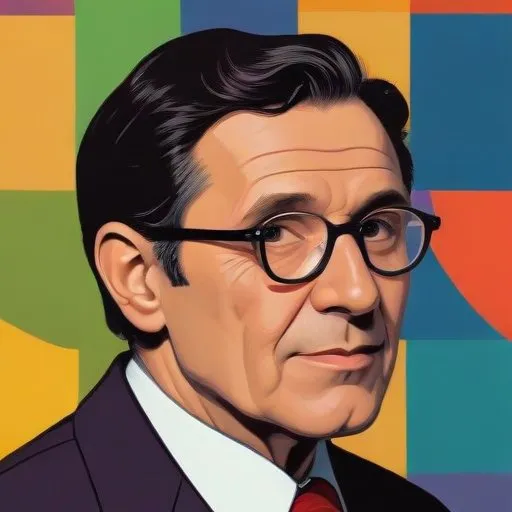
A pioneering physiologist who uncovered the workings of the human eye and developed a deeper understanding of vision, earning him the Nobel Prize in Physiology or Medicine in 1967.
Haldan Keffer Hartline was a pioneering American physiologist who, along with George Wald and Ragnar Granit, was awarded the 1967 Nobel Prize in Physiology or Medicine for his groundbreaking work on the neurophysiological mechanisms of vision. His remarkable research on the electrical responses of retinas in various species laid the foundation for our modern understanding of visual perception.
Hartline was born on December 22, 1903, in Bloomsburg, Pennsylvania. He pursued his undergraduate studies at Lafayette College in Easton, Pennsylvania, graduating in 1923. His fascination with physiology led him to Johns Hopkins School of Medicine, where he earned his medical degree in 1927 as a National Research Council Fellow.
After completing his medical degree, Hartline traveled to Germany as an Eldridge Johnson traveling research scholar, studying at the universities of Leipzig and Munich. Upon his return to the United States, he joined the Eldridge Reeves Johnson Foundation for Medical Physics at the University of Pennsylvania, working under the directorship of Detlev W. Bronk.
In 1940-1941, Hartline served as Associate Professor of Physiology at Cornell Medical College in New York City. He then returned to the University of Pennsylvania, remaining until 1949, when he became Professor of Biophysics and Chairman of the Jenkins Department of Biophysics at Johns Hopkins University.
In 1953, Hartline joined the staff of Rockefeller University, New York City, as Professor of Neurophysiology. During his tenure, one of his graduate students, Paul Greengard, also went on to win the Nobel Prize.
Hartline's most notable contribution to the field of physiology was his pioneering research on the electrical responses of retinas in various species. He focused on the eye of the horseshoe crab (Limulus polyphemus), measuring the electrical impulses sent by single optic nerve fibers when stimulated by light.
Using minute electrodes, Hartline discovered that the photoreceptor cells in the eye are interconnected, such that when one is stimulated, others nearby are depressed. This finding provided crucial insights into the mechanisms of vision and laid the foundation for future research.
In recognition of his groundbreaking research, Hartline was awarded the 1967 Nobel Prize in Physiology or Medicine, along with George Wald and Ragnar Granit. He also received numerous honors, including the Albert Lasker Award in 1953 and the National Medal of Science in 1964.
Hartline's work has had a profound impact on our understanding of visual perception, paving the way for significant advances in the fields of physiology, neuroscience, and ophthalmology. His discoveries have also led to the development of new treatments for visual disorders and diseases.
Today, Hartline's legacy continues to inspire scientists and researchers, serving as a testament to the power of dedication and curiosity in advancing human knowledge.
Born in 1917
A Nobel Prize-winning physiologist and biophysicist who uncovered the mechanisms of nerve impulses, revolutionizing our understanding of the human body's electrical signals.
Born in 1903
A Nobel Prize-winning neurophysiologist who discovered the chemical synaptic transmission of nerve impulses, revolutionizing our understanding of the human brain. His work has had a profound impact on the field of neuroscience.
Born in 1900
A Finnish-Swedish physiologist who discovered the workings of the retina and developed the concept of receptive fields, earning him the Nobel Prize in Physiology or Medicine in 1967. His work laid the foundation for modern neuroscience and visual perception research.
96 Years Old
A pioneering neuroscientist and psychiatrist who unraveled the mysteries of memory and learning, earning a Nobel Prize for his groundbreaking work on the physiological basis of memory storage.
Born in 1926
A Nobel Prize-winning neurophysiologist who uncovered the inner workings of the visual cortex, revealing how the brain processes visual information. Their groundbreaking research revolutionized our understanding of the human brain.
Born in 1924
A Swedish neurophysiologist and academic who discovered the organization and function of the visual cortex, and was awarded the Nobel Prize in Physiology or Medicine in 1981 for his work on the brain's visual system.
Born in 1916
Pioneering scientist who discovered the structure of DNA, revolutionizing our understanding of genetics and life itself.
