


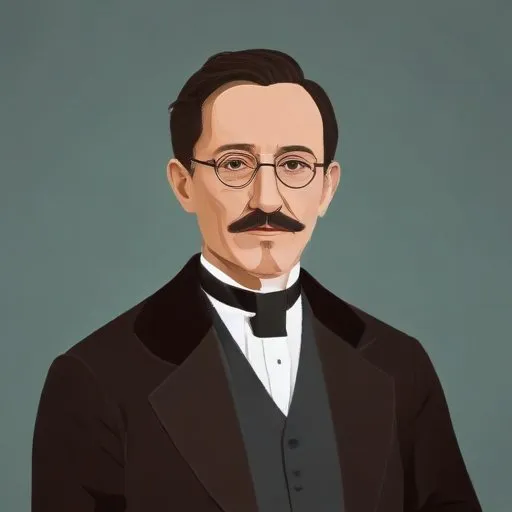
Developed mathematical methods for relativity and quantum mechanics, and pioneered the Fast Fourier Transform algorithm.
Cornelius Lanczos, a Hungarian-American mathematician and physicist, is renowned for his groundbreaking contributions to the field of relativity, earning him a spot among the esteemed group of scientists known as "The Martians." Lanczos' work on the Einstein field equation led to the discovery of an exact solution, now known as the van Stockum dust, which represents a cylindrically symmetric rigidly rotating configuration of dust particles.
Born on February 2, 1893, in Fehrvár, Kingdom of Hungary, to Jewish parents, Kornél Lőwy and Adél Hahn, Lanczos showed an inclination towards mathematics and physics from an early age. He pursued his Ph.D. thesis in 1921, focusing on relativity theory, and sent a copy to Albert Einstein, who responded with praise, acknowledging Lanczos' "competent and original brainwork."
Lanczos' fascination with relativity led him to work under the guidance of Albert Einstein in the late 1920s. During this period, he developed an exact solution to the Einstein field equation, which was later rediscovered by Willem Jacob van Stockum. This solution, now known as the van Stockum dust, is considered one of the simplest and most important exact solutions in general relativity.
In 1927, Lanczos married Maria Rupp, and shortly after, he accepted a one-year visiting professorship at Purdue University. For over a decade, he split his time between Hungary and the United States, teaching graduate students matrix mechanics and tensor analysis. During this period, he also published several papers on relativity, cementing his reputation as a leading expert in the field.
Lanczos' personal life was marked by tragedy when his wife, Maria, passed away in 1939 due to tuberculosis. His son, Elmar, was just six years old at the time. Lanczos' dedication to his work and family is a testament to his resilience in the face of adversity.
Cornelius Lanczos' contributions to relativity have had a lasting impact on our understanding of the universe. His work has inspired generations of physicists and mathematicians, and his discovery of the van Stockum dust remains an essential part of general relativity. Lanczos' legacy serves as a reminder of the power of human ingenuity and dedication to advancing our knowledge of the cosmos.
"The mathematician's patterns, like the painter's, must be beautiful; the ideas, like the colors, must fit together in a harmonious way." - Cornelius Lanczos
Lanczos' work on relativity was part of a broader cultural and scientific movement of the early 20th century. His contemporaries, including Albert Einstein, Werner Heisenberg, and Niels Bohr, were also pushing the boundaries of human knowledge in their respective fields. Lanczos' legacy is a testament to the power of collaboration and intellectual curiosity.
Born in 1879
A brilliant physicist who developed the theory of relativity and is considered one of the most influential scientists of the 20th century, known for his groundbreaking work in physics and mathematics.
Born in 1885
A pioneer in quantum mechanics, he introduced the concept of wave-particle duality, revolutionizing our understanding of atomic structure. His philosophical approach to science also explored the nature of reality and human understanding.
Born in 1901
A pioneer in quantum mechanics, he formulated the uncertainty principle, which revolutionized our understanding of the atomic world. His groundbreaking work reshaped modern physics.
Born in 1902
A brilliant mind who formulated the Dirac equation, a fundamental concept in quantum mechanics, and predicted the existence of antimatter. His work revolutionized our understanding of the universe.
Born in 1903
Pioneering mathematician and physicist who developed the concept of the modern computer architecture and made significant contributions to quantum mechanics and game theory. His work laid the foundation for modern computing and artificial intelligence.
Born in 1910
A renowned scientist who pioneered our understanding of black holes and the behavior of stars, earning a Nobel Prize in Physics in 1983.
Born in 1901
A pioneer in nuclear physics, known for leading the team that developed the first nuclear reactor and playing a crucial role in the development of the atomic bomb.
