


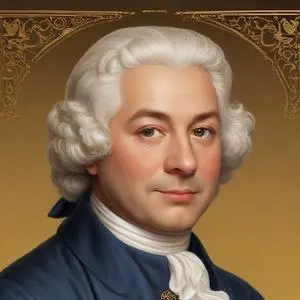
This 18th-century polymath is renowned for his groundbreaking work on fluid dynamics, particularly the Bernoulli's Principle, which explains the relationship between pressure and velocity in fluids.
Daniel Bernoulli, a Swiss mathematician and physicist, is renowned for his groundbreaking applications of mathematics to mechanics, particularly fluid mechanics, and his pioneering work in probability and statistics. His name is immortalized in the Bernoulli's Principle, a fundamental concept describing the conservation of energy, which has significantly impacted the development of two crucial technologies of the 20th century: the carburetor and the airplane wing.
Born on February 8, 1700, in Groningen, Netherlands, Daniel Bernoulli was part of a distinguished family of mathematicians. His family, originally from Antwerp, had emigrated to Basel, Switzerland, to escape persecution of Protestants by the Spanish. Daniel was the son of Johann Bernoulli, one of the early developers of calculus, and nephew of Jacob Bernoulli, an early researcher in probability theory and discoverer of the mathematical constant e.
Daniel Bernoulli's academic brilliance was evident from an early age. He studied medicine at the University of Basel, but his true passion lay in mathematics. His father, Johann, encouraged him to pursue business, citing poor financial compensation for mathematicians. However, Daniel's interests led him to participate in a scientific contest at the University of Paris, where he tied for first place with his father. This led to a strained relationship between the two, with Johann allegedly plagiarizing key ideas from Daniel's book Hydrodynamica and backdating them to before the publication of Hydrodynamica.
Daniel Bernoulli's magnum opus, Hydrodynamica, published in 1738, laid the foundation for modern fluid mechanics. In this work, he presented his groundbreaking theory on the behavior of fluids, which later became known as Bernoulli's Principle. This principle states that the pressure of a fluid decreases as its velocity increases, and has far-reaching implications for various fields, including aerodynamics, hydroelectric power, and engineering.
Bernoulli's work extended beyond mathematics and physics to philosophical and theological debates. He was a strong advocate for the concept of a supreme being, citing the intricate design and order in the natural world as evidence. His philosophical views were influenced by his Protestant upbringing and his fascination with the works of Sir Isaac Newton.
Daniel Bernoulli's pioneering work has had a profound impact on modern society. His principle has been instrumental in the development of various technologies, including aeroplanes, turbines, and pumps. His contributions to probability theory and statistics have also influenced fields such as economics, medicine, and social sciences.
Daniel Bernoulli's work has inspired numerous literary and artistic works. His principle has been referenced in literature, such as in Thomas Pynchon's novel Gravity's Rainbow, and in popular culture, including in films and documentaries on aerodynamics and engineering.
Bernoulli was elected a Fellow of the Royal Society in 1750, recognizing his outstanding contributions to mathematics and physics. He also received an honorary degree from the University of St. Andrews in Scotland.
Born in 1707
Pioneering mathematician and physicist who made immense contributions to fields like calculus, number theory, and optics, shaping the course of modern mathematics and physics.
Born in 1646
Developed calculus independently of Isaac Newton, and made major contributions to the fields of philosophy, politics, and history.
Born in 1667
A renowned 17th-century mathematician who made significant contributions to the development of calculus, probability, and optics, leaving an indelible mark on the scientific community.
Born in 1473
A Renaissance-era mathematician and astronomer who proposed the heliocentric model, where the Sun is at the center of our solar system, revolutionizing our understanding of the universe.
Born in 1564
Pioneering astronomer, physicist, and mathematician who played a major role in the Scientific Revolution, making key discoveries that challenged Aristotelian views and laid the foundation for modern science.
Born in 1623
A 17th-century genius who made major contributions to mathematics, physics, and philosophy, inventing the mechanical calculator and developing the theory of probability. His writings also explored the human condition and faith.
Born in 1629
A 17th-century polymath who made groundbreaking contributions to optics, probability theory, and astronomy, including the discovery of Saturn's rings and the largest moon, Titan.
