


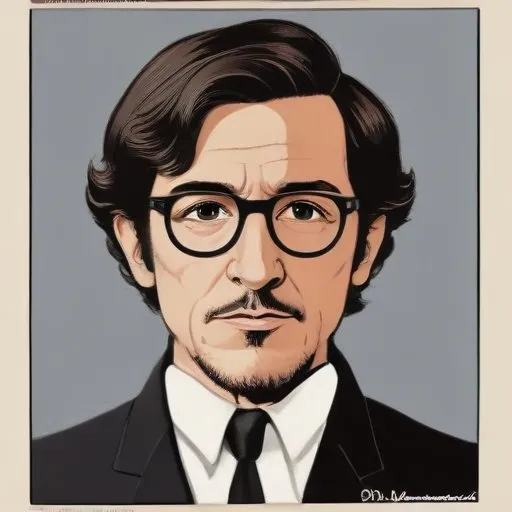
A French musicologist and philosopher who explored the relationship between music, philosophy, and culture, and wrote extensively on the intersection of art and thought.
Daniel Charles was a French Renaissance man, renowned for his profound impact on the realms of music, philosophy, and aesthetics. As a musician, musicologist, and philosopher, Charles wove a rich tapestry of creative expression, leaving an indelible mark on the cultural landscape of the 20th century.
Born on November 27, 1935, in Oran, Algeria, Charles' life was a symphony of intellectual curiosity and artistic passion. He pursued his musical studies at the Paris Conservatory of Music, where he earned the First Prize in 1956. This distinction was followed by the aggregation in philosophy in 1959, and later, a PhD under the guidance of Mikel Dufrenne in 1977.
Charles' encounter with John Cage in 1958 marked a pivotal moment in his career. He became an ardent advocate for Cage's music and philosophy, introducing his work to French audiences. Their collaborative project, Pour les oiseaux, published in 1976, remains a seminal work in the canon of modern musicology. This groundbreaking book not only cemented Charles' reputation as a leading authority on Cage's oeuvre but also provided a platform for exploring the intersections of music, philosophy, and aesthetics.
Throughout his academic career, Charles held esteemed positions at the University of Paris VIII Vincennes, the University of Paris IV Sorbonne, and the University of Nice Sophia-Antipolis. As a visionary educator, he fostered a new generation of scholars, encouraging them to traverse the boundaries of traditional disciplines. His pedagogical approach, which emphasized the interconnectedness of music, philosophy, and aesthetics, has left a lasting impact on the academic community.
Charles' intellectual reach extended far beyond the confines of his native France. He was a sought-after lecturer, invited to universities across the Atlantic, as well as in Japan and the Philippines. His published works, including five books translated into German and two into Japanese, have resonated with scholars and practitioners worldwide.
Daniel Charles' extraordinary life, marked by a devotion to the pursuit of knowledge and creative expression, has bequeathed a rich cultural heritage. As we reflect on his remarkable journey, we are reminded of the transformative power of interdisciplinary scholarship, and the enduring beauty of the melodic bridge he built between music and philosophy.
96 Years Old
A French sociologist, anthropologist, and philosopher who developed the concept of "cultural capital" and critiqued social inequality, highlighting how power and privilege are maintained through cultural and symbolic means.
Born in 1905
Existentialist philosopher and playwright who argued that humans have complete freedom to choose their actions and create their own meaning in life, influencing modern thought on morality and individual responsibility.
Born in 1915
A French philosopher, theorist, and critic who challenged traditional notions of culture, literature, and identity through his influential writings on semiotics, mythology, and structuralism. He's most known for his critical theories on modern society and culture.
Born in 1926
A French historian and philosopher who critiqued power structures and social norms, arguing that knowledge and truth are shaped by those in power. He's known for his concepts of power, discipline, and surveillance.
Born in 1925
A French philosopher who developed influential concepts like "rhizome" and "desire-machines," which challenged traditional notions of identity, reality, and power.
96 Years Old
A pioneer of poststructuralism, deconstructing traditional notions of meaning and challenging Western philosophy's core assumptions. His work redefined the way we think about language, culture, and identity.
Born in 1924
A French philosopher, sociologist, and literary theorist who challenged traditional notions of knowledge, truth, and power, and is famous for his concept of "postmodernism".
89 Years Old
A prominent contemporary philosopher and academic, known for developing the concept of "evental philosophy" and applying it to various fields, including politics, ethics, and aesthetics.
